Revisiting Final Fantasy XIII
Somewhere In Between

When I was a teenager, as soon as I learned about the negative fan reception of Final Fantasy XIII, I wanted to write a defensive retrospective about it. I first played Final Fantasy XIII back in 2011, when the game was still relatively fresh and its reception from fans of older Final Fantasy titles was brutal. Even not that far out from its initial North American release, the game was considered by some to be the black sheep of the franchise. If more critical fans would begrudgingly try to give it credit, they would state things along the lines of “it may be a good game, but it’s a horrible Final Fantasy.”
During that time, I felt a need to defend the game for reasons of youth, inexperience, and a deep personal attachment to Final Fantasy XIII. In 2011, I was a wee 13-year-old who had only ever played games on Nintendo consoles up until that point. Initially, when I got a PS3, I just wanted to play Little Big Planet. Eventually though, while my older sister and I browsed our local GameStop in the following months looking for other PlayStation titles to try on our new console, we were drawn to Final Fantasy XIII.
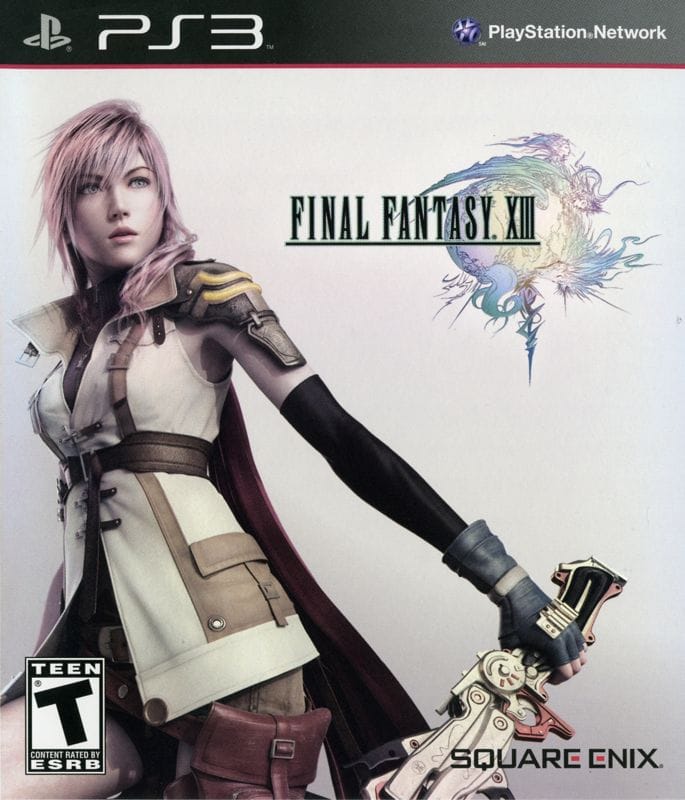
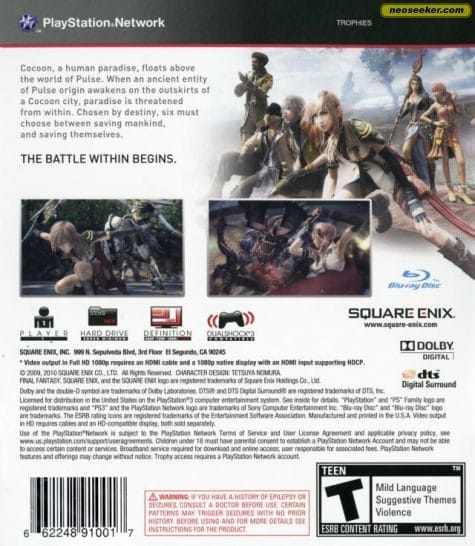
Front and Back Cover of the North American PS3 Release of FFXIII
Looking back on it, I’m not sure what the specific je ne sais quoi was that drew my sibling and I to Final Fantasy XIII. In hindsight, the North American cover of the game is barebones and tells you little to nothing about the game. There’s just the protagonist, Lightning, set against a blank backdrop, holding her gunblade while looking off into the distance as the game’s abstract Yoshitaka Amano logo sits next to her in the white space. The back cover doesn’t do much to clarify things. Sure, you get a more concrete written premise: some location names and a broad set up of the Cocoon vs. Pulse dynamic that defines the game’s conflict. There is also one image of gameplay and another image of an in-game cut scene. However, this brief description and the screenshots do very little to clarify what playing the game is like. Initial impressions are vague to say the least.
During that GameStop visit, my sibling and I actually didn’t purchase the game. An employee warned us against it and recommended Fallout: New Vegas instead if we wanted to try playing an RPG. As mentioned before though, up until that point we only played Nintendo games, so this recommendation was essentially meaningless to us. In the end, we didn’t purchase the game right off the bat, but my sister ended up borrowing a copy from her friend a couple weeks later.
What happened after that is imprinted in my mind: a defining memory. My sister booted up the game on our flat screen TV, and it was like entering a whole new world. I had never seen a game like Final Fantasy XIII before. The cinematic cut scenes, intense focus on narrative storytelling, and semi-turn-based combat were awe inspiring, breathtaking even. After watching my sister play through the opening chapters, I quickly picked it up to play it myself.
For a while, it was my hyper fixation. I played it twice over the course of a year, including completing all of the game’s Cieth Side Quest missions in one of those playthroughs. Back then, time seemed to work differently. Even though it was only a year, I felt lost in the game and like I would never find my way out of it. As crazy as this might sound for older generations of Final Fantasy fans introduced to the franchise via titles like VI, VII, and X, Final Fantasy XIII was my introduction to the series and Japanese RPGs as a genre.
The reason I’ve never written a defensive post about Final Fantasy XIII since those early first impulses to do so are plentiful. The main one is that, over time, I did come to understand criticisms of the game. As I grew older and started to play more Final Fantasy titles and other RPGs, I realized that for as much as I have a deep personal affection for Final Fantasy XIII, it is not without flaws. What once seemed exceptional during those starry-eyed playthroughs in my youth became a bit more standard and clunky with a bit more cultural context and knowledge about game design.
Additionally, these days in particular, Final Fantasy XIII is not without its defenders! Back during the game’s 10th anniversary, games writer and critic Harper Jay wrote an article for Kotaku in defense of the entire Final Fantasy XIII trilogy. A cursory search for video essays about the game on YouTube will give you dozens of results re-examining and even praising the game. Long gone are the days where this title needed defending (if a triple A JRPG ever needed that kind of defense in the first place, which as we will discuss later, is questionable).
So, why am I writing about the game now?
Well, I’ve just kind of had the itch!
As we creep toward the game’s 20th anniversary (a statement which sends shivers down my spine, frankly), I’ve been thinking about its impact on me and the discourse surrounding it during its initial launch. To some extent, I think the fan reaction to the game was unfair, but at the same time the game is undeniably a flawed product of an era of video game design and culture defined by the advent of HD console development and overt xenophobia toward Japanese games and game developers (again, we will get into it). Like all artistic texts, Final Fantasy XIII has aged over time, unlocking new flavors that were always there but have become more prominent in the process of fermentation. Simultaneously, it’s a lot easier to appreciate the unique strengths of the game in retrospect, while also being clear-eyed about its unfortunate portents of the modern state of Square Enix and triple A JRPGs overall.
Final Fantasy XIII, for better or worse, was a turning point for the genre and the Final Fantasy franchise. It was the first Final Fantasy with no involvement from longtime series producer and creator Hironobu Sakaguchi, and the first HD title in the series.
Upon replaying the game in the year of our lord 2026, I must confess that it is not the masterpiece 13-year-old me thought it was. The last time I played the game in full was back in 2012 when I was still a teenager, so frankly I’m not shocked that my opinion on the game has changed. What surprised me more during this replay were the crusty qualities of the game: the messy things not discussed by even the game’s most ardent initial critics and how it acts as a reflection of Square Enix’s approach to game design at a specific point in time.
Is Final Fantasy XIII a masterpiece? A failure? I’d argue it’s somewhere in between.
Part I - The Upsides and Downsides of Linearity:
First, some points of clarification. To start, I am going to be talking about Final Fantasy XIII from the perspective of a Final Fantasy fan growing up in the 2010’s in North America, specifically the United States. I will be touching upon English language developer interviews, but Japanese fan reception and criticism is something I won’t be drawing upon much as I am not fluent in Japanese. Additionally, I want to work to dispel some common misconceptions about the release and critical reception of Final Fantasy XIII in North America and Europe.
These days, and at the time even, it seems like the negative fan reception of Final Fantasy XIII ended up overshadowing the overall positive reception of the game by critics. Most major outlets at the time, like IGN, GameSpot, etc, gave the game positive, sometimes even glowing reviews. The only major exception to this was Edge Magazine who gave the game a middling 5/10. It would be disingenuous to claim there was no negative critical reception, but it does seem that historically it was mostly on the fan side of the equation rather than from professional critics. Not that any professional critic’s approval is a sign of inherent quality, but it does throw into question the perception of the game as being negatively received by a majority of people upon its North American release.
In terms of the aforementioned criticisms of Final Fantasy XIII, the most common ones were related to its linear game design. Going back to the aforementioned Edge Magazine review, the game’s linear design is a major point in the reviewer’s critique. Even before this review though, a negative narrative surrounding the game’s linearity was already being formed online.
Something interesting I discovered in researching initial criticism of Final Fantasy XIII is that fandom debates surrounding the game’s linearity started even before the game’s official English release. In a preview published by the now defunct 1Up.com shortly before the game’s launch in North America in March 2010, writer Jeremy Parish discusses what would become a common point of discourse surrounding the game: “the bulk of chatter about the game (based on impressions of the import version) center around a similar debate…gamers are largely dissatisfied not with the openness of its latter portions but with the stiflingly linear nature of its first chapters.” As Parish points out in this quote, this discourse was not bubbling up in the aftermath of the English release of the game, but from secondhand accounts from people who had imported the Japanese version released the year prior in December 2009.
One of the funniest artifacts I stumbled upon from this time period is a crusty forum post on the website VGChartz. I was trying to search for developer interviews about why traditional JRPG towns weren’t included in Final Fantasy XIII and instead stumbled upon these ancient materials published on January 31st, 2010 (again before the game’s official English release). The first post in the thread rebuts another poster’s argument about the linearity of Final Fantasy XIII being similar to the design of Final Fantasy X, a previous title in the franchise that is also quite linear. In this response post, we see many of the now common counterarguments to this point:
“People keep saying it has FFX towns because they saw someone else say it has FFX towns who saw someone else say it had FFX towns, etc. This idea has spread like wildfire among apologists, and it's completely false. I've got two friends with import copies of the game and it doesn't even come close.”
Aside from the “I’ve got two friends with import copies” being a kind of funny “I have an uncle who works at Nintendo” style rebuttal, it does point to a change that really was occurring during the PS3/Xbox 360 era of console gaming. The PS3 being region free meant that JRPG fans with enough dedication to learn Japanese could just purchase a Japanese copy of a new JRPG and play it on their North American PS3. This is how you then end up with strange situations like this where in the 3 month gap between the Japanese and English release of Final Fantasy XIII you have internal fandom and critical discourse forming around a title that most English-speaking players hadn’t touched yet.
In some ways, these kinds of pre-emptive critiques based on the playthroughs of dedicated Japanese-fluent fans in the Anglosphere are not as common today. Due to the increasingly globalized state of capitalism and the negative press impacts that occurred during these gaps between localized releases in the internet age, Japanese companies for the most part now give their title’s simultaneous global releases. The result is that English-language fandom discourse sprouts up in the aftermath of a game’s release rather than forming in advance via importers leaking details about the game online.
Historical tangent aside though, the argument on this forum also illuminates the common crux of debate around this game. As the 1Up.com article pointed out, the balance between linear storytelling and open world game design has always been a point of tension and debate within Final Fantasy fandom. The article’s opening paragraph highlights a similar debacle around Final Fantasy VI. Similarly, as the forum poster on VGChartz mentioned, Final Fantasy X was also quite a linear game that one could describe in the same ways people have gone on to describe Final Fantasy XIII: a JRPG were you predominantly run through a straight line of a map, engaging in combat encounters as you are funneled to the next story cutscene.
For a long time, I thought these points made critiques of Final Fantasy XIII’s linearity moot. In fact, this Final Fantasy X argument is one that is still used in retrospectives and reevaluations today as evidenced by the Harper Jay Kotaku article, which states:
the common consensus is that Final Fantasy XIII is a game of corridors. A game where you press up on the control stick and occasionally battle in an overly automated combat system. Within the context of the series at that point, that is a somewhat perplexing accusation. Final Fantasy X, which I will suggest is among the most coherent and well put together role-playing games of all time, often features the same level design and corridor structure of Final Fantasy XIII.
There are some things about this defense that I think are worthwhile, especially since Final Fantasy XIII’s director, Motomu Toriyama, was a key staff member in the development of Final Fantasy X. As such, the two games have a shared lineage of game design that explains a lot of the linear choices made for Final Fantasy XIII.
At the same time, complete dismissals of the critiques of Final Fantasy XIII’s linearity don’t feel entirely fair to me. As much as linearity is nothing new for the Final Fantasy franchise, there are issues with XIII’s choice to lean so hard into linearity. Linear game design, like any kind of design, is a neutral tool with strengths and weaknesses. Utilized properly in a game’s design, linearity can serve a game’s narrative storytelling and gameplay. I’d argue that to some extent, Final Fantasy XIII’s linearity does have narrative utility.
For those unfamiliar with the game’s basic premise, Final Fantasy XIII follows a group of fugitives who have been turned into l’cie, a kind of magical servant branded by the mechanical god creatures that rule the world called Fal’Cie. The world of Final Fantasy XIII is split into two major factions: Cocoon and Pulse. Cocoon is an artificial, floating utopia: a commercialized and sleek sci-fi metropolis with a state religion in the form of the Sanctum and an authoritarian Anti-Pulse branch of the military called PSICom. On the other hand, Pulse is considered a wild and dangerous place overrun with monsters by those who live on Cocoon.
When the game kicks off, the Sanctum and PSICom have set out to purge all citizens who came into contact with a Pulse Fal’Cie discovered in the beach side city of Bodhum. Think of it like the genocidal, forced deportations of the modern-day United States. This purge is what brings all our characters together and into contact with the Pulse Fal’Cie who turns them into l’cie. When you become a l’cie, you are branded and given a vision that is supposed to tell someone how to complete their “Focus,” i.e. the task the Fal’Cie wants you to accomplish. If you fail to accomplish the task quick enough, you turn into a monster called a Cieth. If you do complete it, you are turned into crystal and granted eternal life. The game after this point centers itself on the six playable characters as they struggle to determine what their Focus is and whether or not they even want to complete it.
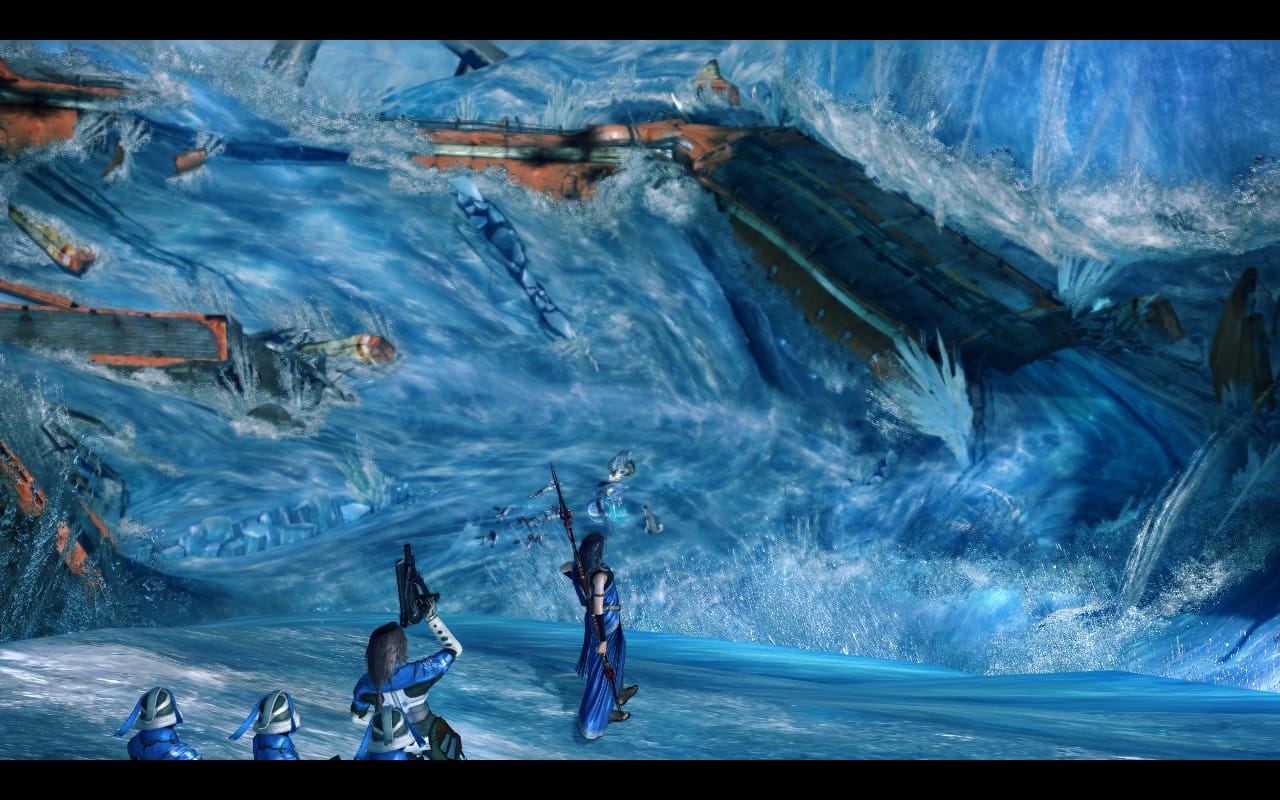
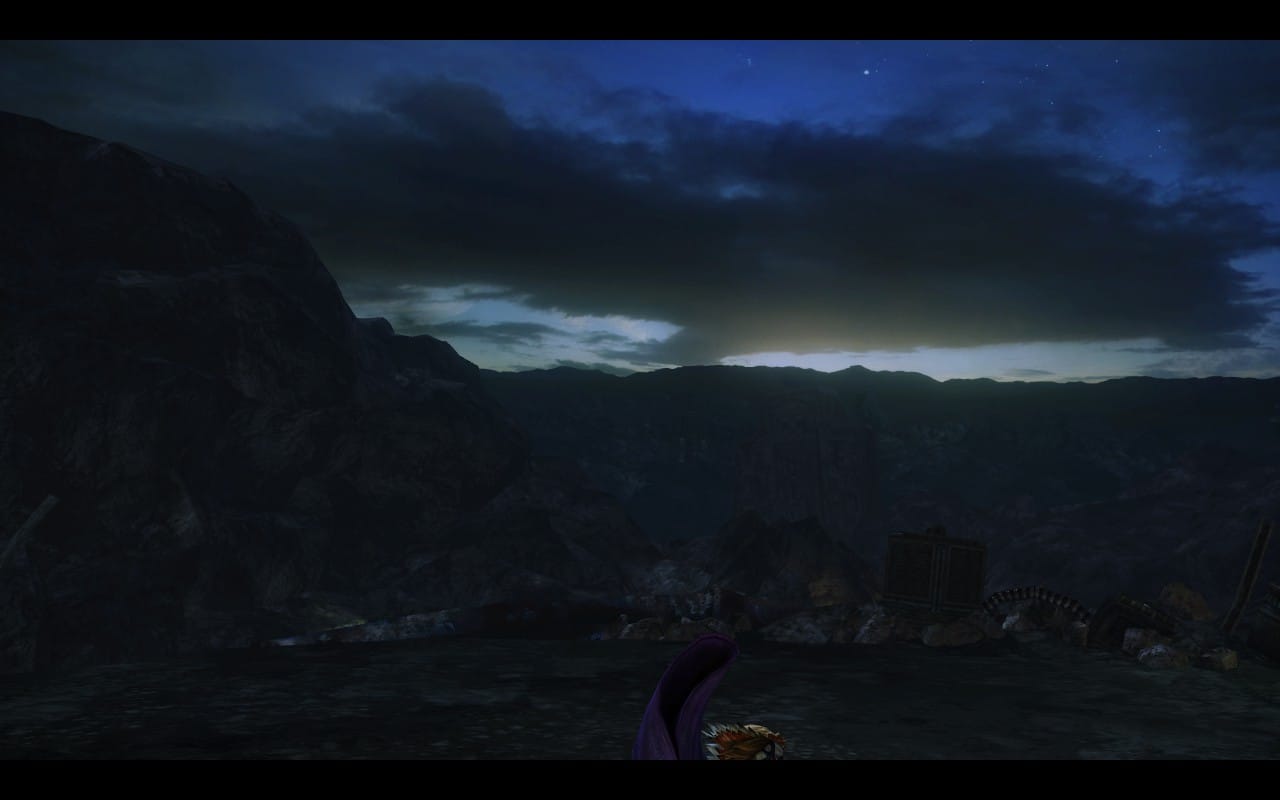
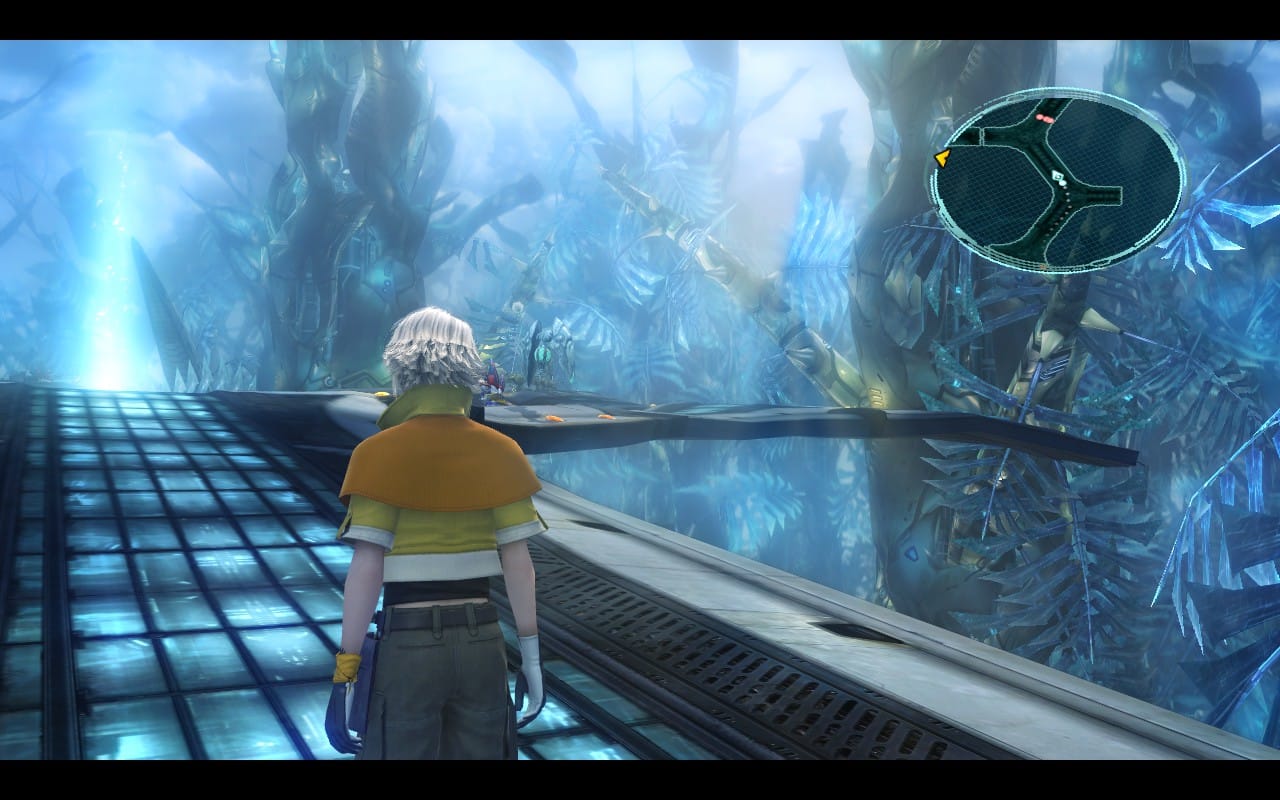
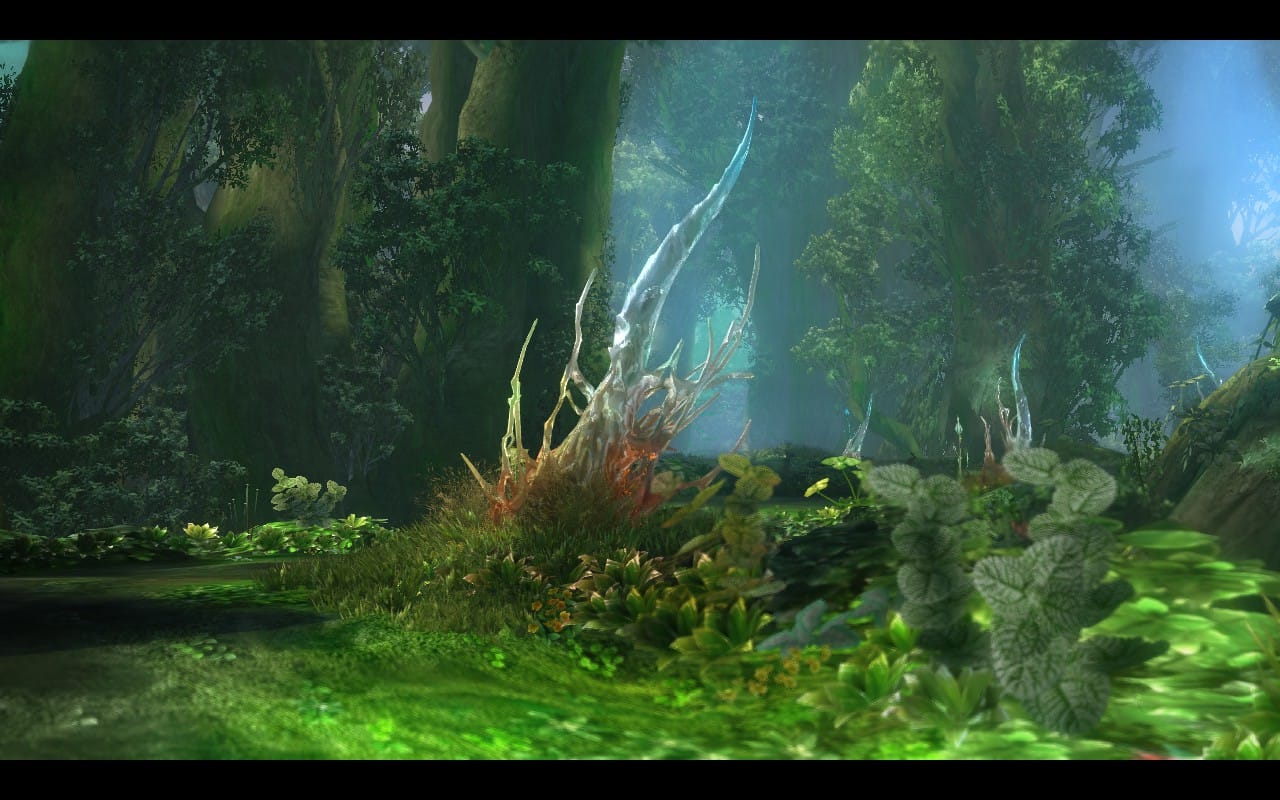
Screenshots from Lake Bresha, Vile Peaks, Gapra Whitewood, and Sunleth Waterscape
As l’cie on the run from Cocoon’s military, the linear approach to game design makes a lot of narrative sense. It lends to the sense of tension that these characters would undoubtedly be under as fugitives hunted down by their government. The idea that these characters would be able to walk into towns and casually convene with local citizenry on Cocoon is a tad silly. Certainly, in a more fantastical, medieval, or early industrial setting, you could maybe justify some casual town visits. Final Fantasy XIII’s Cocoon though is a world much like modern North America. There are security cameras, futuristic military guns, war machines, and airships—this is not a space that suggests easy escape from surveillance and state violence.
The locations of the opening chapters reflect this fugitive narrative. Most of the spaces explored in Final Fantasy XIII are quite liminal, particularly in the first Cocoon-focused section of the game. As a result, Cocoon takes on a claustrophobic and manufactured quality. The characters wander through a lake turned into crystal, abandoned ruins, junkyards filled with Pulse trash left to rot, military facilities where animals are studied and reproduced as war machines, and nature reserves filled with hostile creatures.
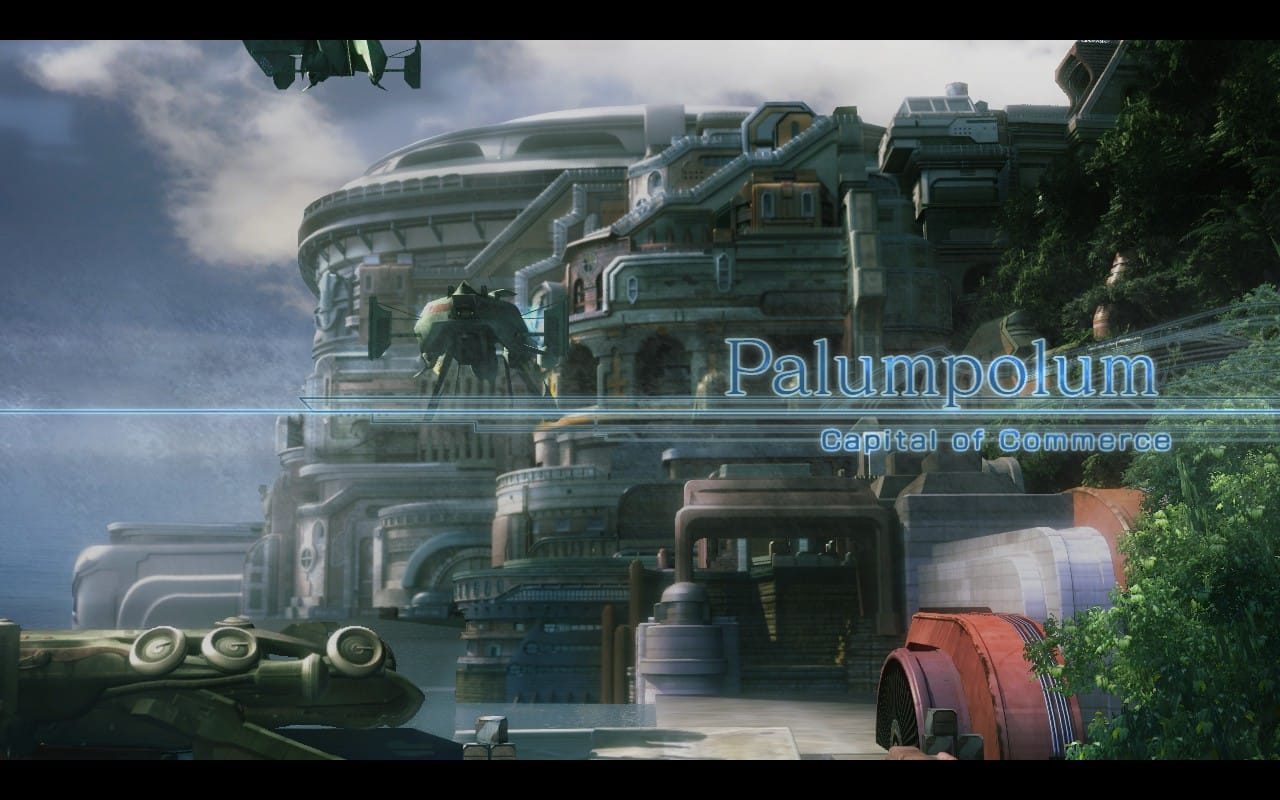
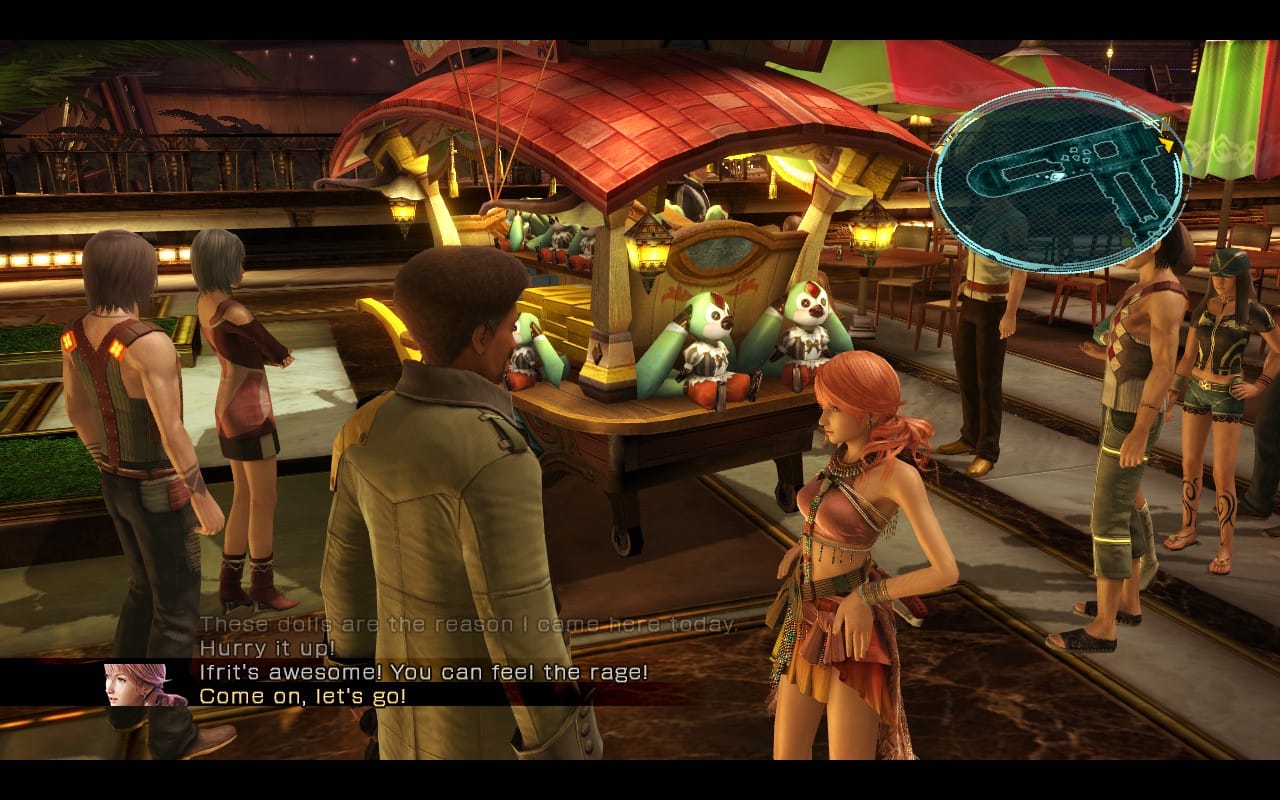
Screenshots of Palumpolum and Nautilus
When you finally do get to actual locations inhabited by people, like Palumpolum in Chapter 7 and the Nautilus theme park in Chapter 8, they are hyper commercialized and artificial. Palumpolum is a center for shipping and commerce with shopping malls and high-rise apartments turned into warzones under the pursuit of the fugitive l’cie. Meanwhile, Nautilus is like a government sanctioned Disneyland filled with attractions and spectacle meant to push a standardized narrative of the history of the Cocoon vs. Pulse conflict. These spaces feel empty and without real life and human interaction because they are hyper manufactured spaces that showcase the farce of Cocoon society: the ways its sleek surfaces and aesthetics mask an authoritarian state where the people are distracted by commercialism and spectacle.
Additionally, the linearity allows the developers to direct players through a strong narrative arc. The first 9 chapters of the game all feel like they are building to the moment where all six playable characters are finally united and discover the truth behind the Sanctum and its Primarch. Linearity helps create this sense of narrative propulsion and makes the moment where everything comes together more satisfying as a result. In terms of gameplay, it also creates a simultaneous moment of tension release since this is where combat really starts to open up and become more customizable as well. Similarly, when the linearity ceases from a design perspective and you enter the open world of Gran Pulse a few hours later, it acts another release valve for the tension and claustrophobia that defined the previous hours of the game.
However, to act like the linearity of Final Fantasy XIII only has positive impacts would be silly. A rebuttal to my previous points is rather apparent. Sure, linearity may give the game a stronger sense of narrative propulsion and highlight the dystopian, fugitive elements of the game’s setting and narrative, but these are ultimately choices that the developers could’ve chosen not to make or at least lean into a little less.
One of the negative effects of the linear game design is that the lack of traditional JRPG town elements--shopkeepers, NPCs you can talk to, and spaces where one can engage in downtime from combat and simply explore civilian locations—results in the everyday citizens of Cocoon feeling rather inhuman. Throughout the game’s narrative, it’s hard to get a sense of what the perspective of the average Cocoon citizen is. Through the central characters and military and government figureheads, we can get some sense of things. It’s clear that the government heavily pushes an anti-Pulse narrative and that some of them are convinced to celebrate the Purge of innocent civilians as a result, but are all Cocoon citizens so willing to believe their government’s propaganda?
We occasionally get evidence that this is not the case with characters like Hope’s dad and the members of the Cavalry, but overall most average Cocoon citizens in their incidental dialogue are portrayed as paranoid and easily swayed to the side of state violence. The major exception to this is Snow Villier’s militia(?), activist group(?) N.O.R.A. However, N.O.R.A. is barely developed beyond an anti-authoritarian, vaguely anti-Fal’Cie stance. It’s not like we ever get a segment of the game where Snow talks to his team members about ideology and politics. It’s all rather vague and non-specific. Having more time for our main playable characters to talk to the people of Cocoon would do a lot to flesh out the game’s worldbuilding. Cocoon is commercialized, articifical, and authoritarian, but without a diverse populace to interact with those atmospheric and worldbuilding elements flatten the entire place into a bit of a caricature of itself.
Of course, time and interviews with developers of Final Fantasy XIII have revealed some of the practical development reasons for the lack of NPCs and towns in the game. Allegedly, these choices that lean into the linearity of the game design weren’t merely for narrative reasons but also done out of technical necessity. Oft not mentioned in conversations around Final Fantasy XIII is the game’s nature as the first HD title for the franchise. It was the first mainline Final Fantasy released on the PS3 and was developed with a custom game engine created by Square Enix. This new technical ground being covered, combined with Square Enix’s obsession with visual fidelity, is rumored to have resulted in performance issues that forced the game to make some creative compromises. The main source of this is a translated quote from Final Fantasy XIII Ultimania found in several questionable news articles and fandom wikis. Considering that Ultimania has never been officially localized, I tried to see if I could locate more concrete English language interviews around this topic.
In one interview from 2010 with Game Developer.com (then known as GamaSutra), Final Fantasy XIII’s director, Motomu Toriyama, discusses how the HD development and the long development time meant some content cuts had to be made, including towns:
…in the Final Fantasys on previous, non-high definition consoles, we were able to kind of take everyone's ideas and include all of them in the game – kind of a bento box system, where you have all the different little things in there. So we had mini-games or we had towns where you were able to talk to all of the townspeople. But with a high definition console you're really no longer able to do that because it takes so long to develop. When you think about how long it's already taken us to develop this game, to have to have included all of those other aspects it would have been far too long. So what we did instead was to define what was truly important to the game and include those aspects and really emphasize those items that we wanted.
This quote points to the difficulties of HD development for a team who, up to that point, was developing titles for the non-HD PS2. The necessary leaps in development cost, fidelity, and technique required for Final Fantasy XIII would’ve been undeniably hard to make as evidenced by the game taking three years to launch after its initial announcement at E3 in 2006.
Really though, beyond developer interviews, it only takes playing Final Fantasy XIII to intuit that the game likely ran into technical issues when trying to create traditional JRPG towns. It doesn’t seem to have just been an issue with development timelines. The areas in the game where multiple NPC character models exist on screen are also some of the only areas where the game’s frame rate dips below 30 FPS. For example, Nautilus, which is one of the only truly dense human areas in the game, has some of the most visible frame drops. Given the game’s already protracted development, these technical issues likely made it too difficult for the developers to implement any kind of traditional JRPG towns.
However, I’d argue that towns aren’t the real culprit of Final Fantasy XIII’s central gameplay issues or what makes the linearity such a sticking point for many players. Instead, I’d point to the lack of gameplay variety that occurs in these linear spaces. The gameplay loop for Final Fantasy XIII is monotonous. Each new area brings with it the same structure: a hallway, some combat encounters, and a cutscene waiting for you at the end. There may be some branching paths in the area—different routes and a treasure orb off the beaten path—but these diversions offer little more than a brief distraction that will eventually funnel you back to the main hallway. Oftentimes, these branching paths and treasure orbs just introduce you to new, slightly more challenging or easier combat encounters. Technically, yes, you can avoid all combat encounters as enemies are visible on the field. However, given the game’s floaty camera controls, slow walking speeds, and the limited amount of stealth items available to the player, most of the time when you see enemies on the field you will end up in combat with them.
To compare XIII with a similarly linear title, Final Fantasy X has a similar structure, but it breaks up the structure of hallways, combat encounters, and cutscenes with mini-games, NPC interactions, and explorable civilian settings. These aspects give players downtime where they can relax and just… not think about combat for a second. XIII does not have this variety for the most part. It isn’t until Chapter 11 when the characters find themselves on Gran Pulse that the game “opens up” and side quests are introduced.
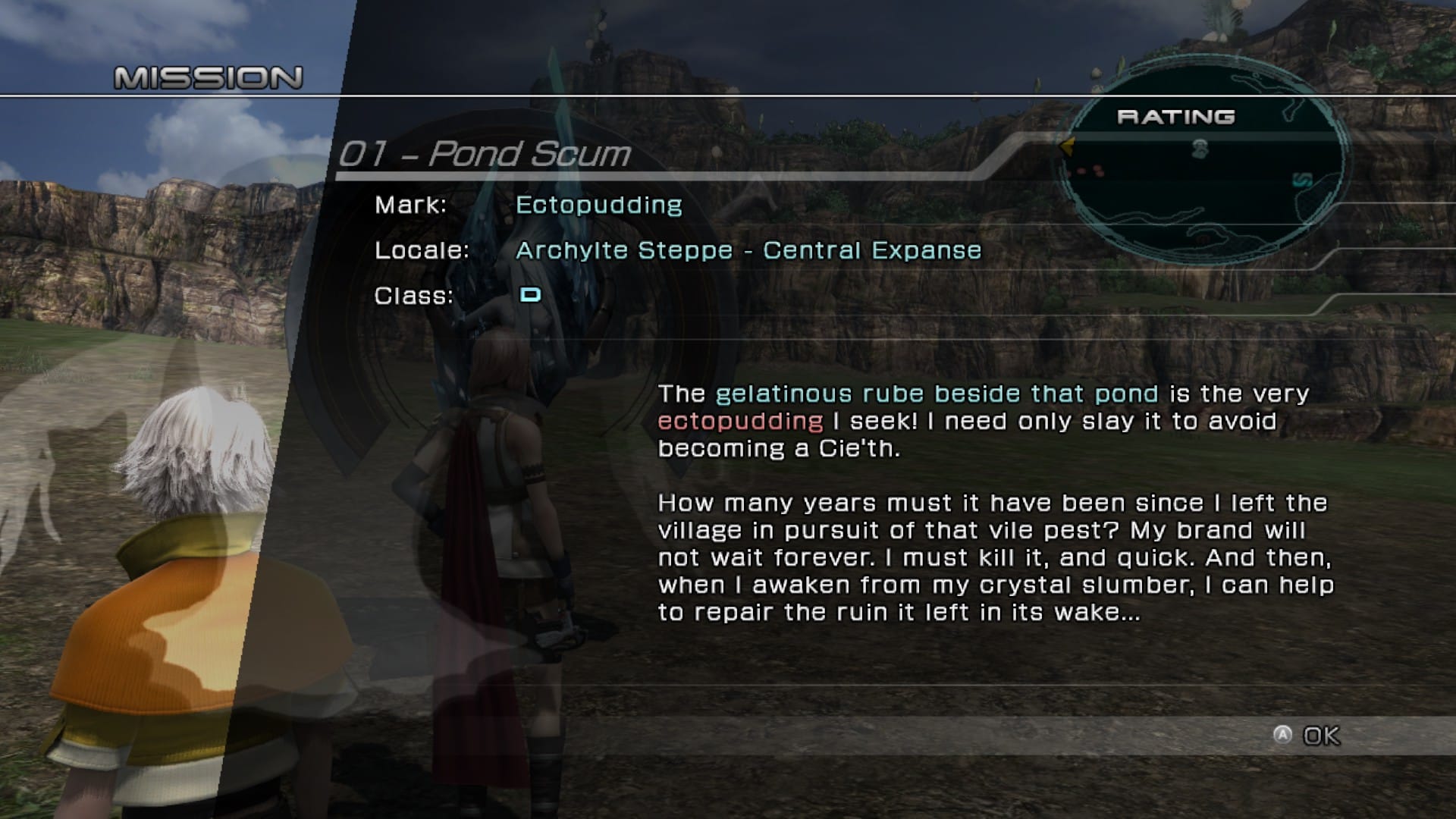
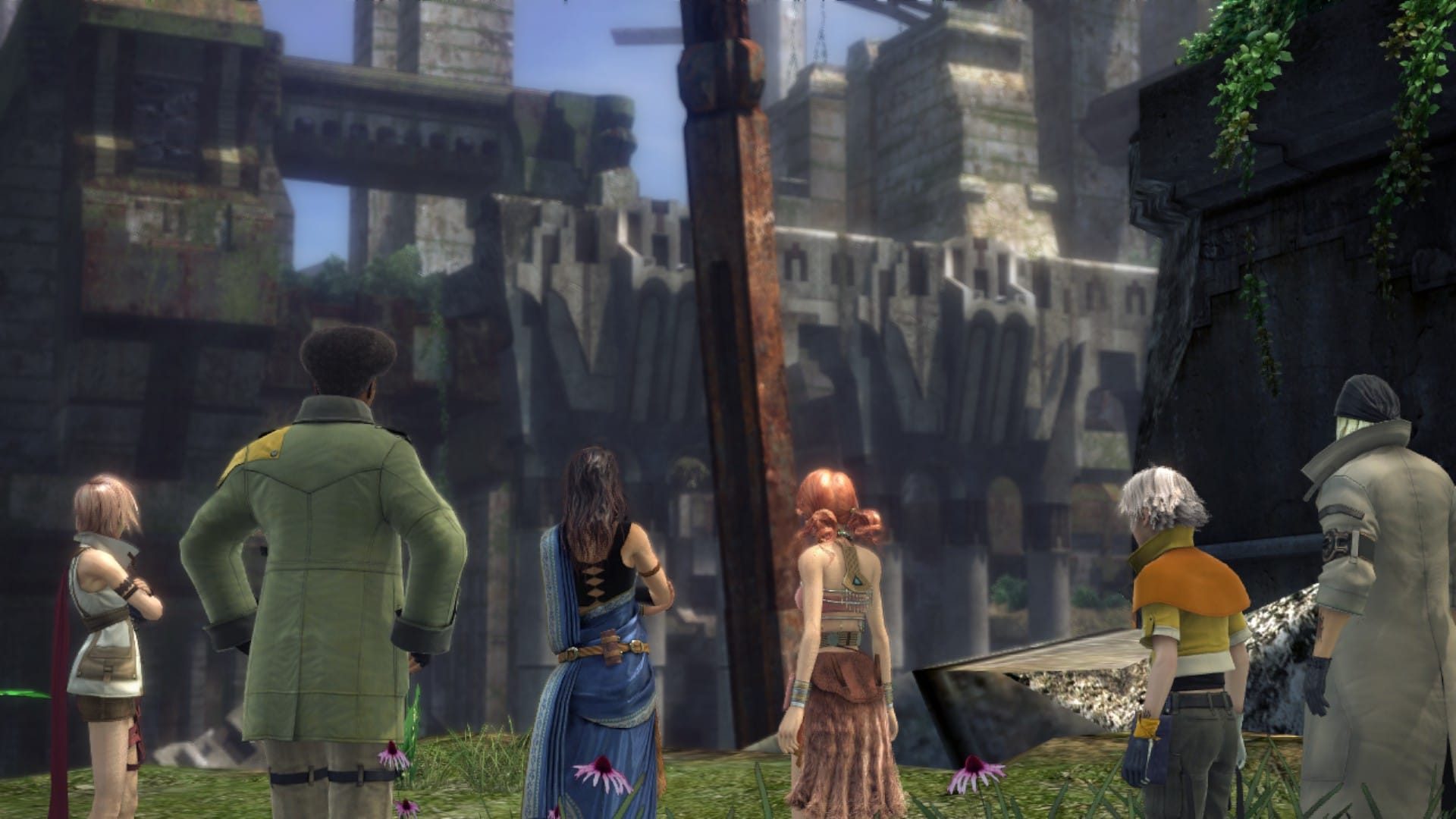
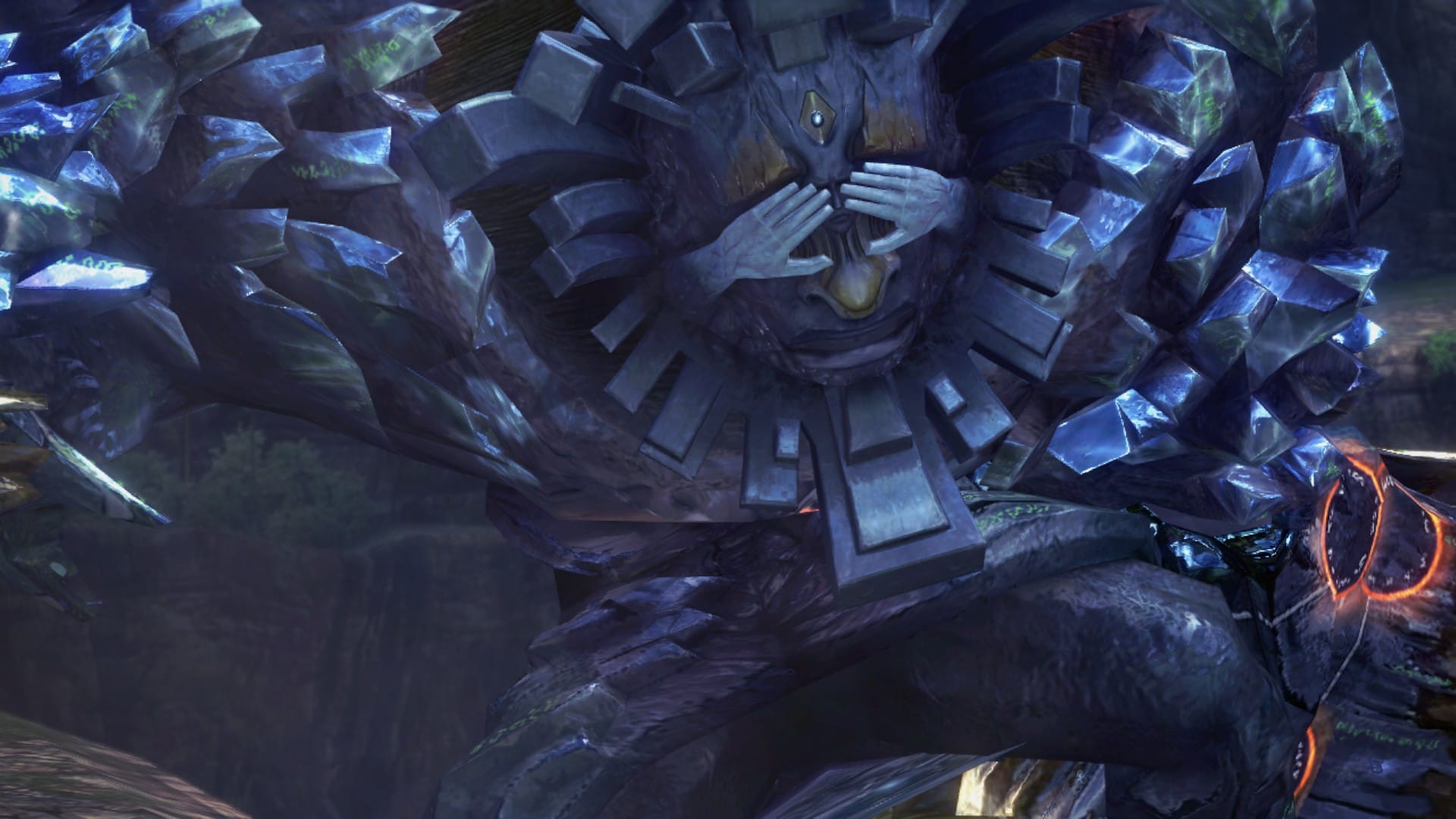
Examples of the Cieth Stone Missions/Gran Pulse Gameplay
Unfortunately, these open world and side quest elements don’t do much in the end to change the fundamental grind of Final Fantasy XIII’s gameplay. Sure, Gran Pulse has a big open field and some optional side areas, but what you’ll find in these locations are much the same as before: combat encounters and cut scenes. The main side quests on Pulse, the Cieth Stone Missions, are all optional combat encounters. Due to the game restricting players to taking on one mission at a time, the game ends up recreating the same exact structure as before. You accept a quest, follow the map marker to that encounter, and kill the enemy. Sometimes there might be a special cutscene!
This is not what I’d call a great form of gameplay variety when a majority of the game’s dungeons and areas already consist of combat encounters. Later on, if you complete enough of the Cieth missions, players do eventually unlock the Gauntlet style arena called Titan’s Faultwarrens. This is better than nothing, I suppose, but this content is something that most players won’t experience unless they play with the new stat upgrades unlocked after beating the game’s final boss.
Part of what contributes to the monotony though is the actual design of the dungeons themselves. Again, linearity is not the problem, but rather the shear lack of things to do in these dungeons. Minor mechanics are occasionally introduced. For example, when I entered the Gapra Whitewood and Lightning warned Hope that people often get lost here and so he should follow the glowing lights on the pathway, I was filled with a sense of anticipation. Finally, a gameplay mechanic to differentiate this area from the previous one! Revolutionary!
Alas, this mechanic ended up being not much. There are glowing points on the path that theoretically guide the player to elevators in the dungeon, but the game map reveals that this area is just as a straight a line as any other location in the game. The most fleshed out mechanic in a dungeon occurs in Chapter 6. In the Sunleth Waterscape, Sazh and Vanille have to use water orbs that change the area’s weather. This is a fun little navigational puzzle: it forces players to consider which option to choose as certain weather conditions can spawn enemies too challenging for your current stats and levels.
A similar little navigational puzzle occurs in Chapter 9, where in the section before the final boss of the chapter, players have to activate mechanical bridges in order to progress. These bridges similarly allow players to potentially circumvent more difficult combat encounters by avoiding certain platforms. Since this is also the first area where players can actually customize their party layout, this makes it a good place to explore and test out new combat options as well.
Unfortunately, that’s about as complex as things get. The game’s design gets especially bad in the latter half of the game where the amount of combat encounters and their difficulty increase exponentially. Chapter 12 and 13 are tests of patience as the player is forced to wade through areas where the only choices provided to players are which combat encounters to avoid and take on. Sometimes, as is the case with one section in Chapter 13, the player is not given a choice and must engage in fighting the same mini-boss encounters they just experienced 15 minutes ago, but this time back-to-back. It’s a test of endurance, but maybe not in the way the developer’s intended.
Attributing all of these linear design decisions to just technical limitations doesn’t feel fully accurate. The development team’s defense of these decisions as the result of differences in Japanese and Western RPG design also come across as not entirely accurate either. As stated by Toriyama in a CVG interview post the English release of Final Fantasy XIII:
We think many reviewers are looking at Final Fantasy XIII from a western point of view. When you look at most Western RPGs, they just dump you in a big open world, and let you do whatever you like... [It] becomes very difficult to tell a compelling story when you're given that much freedom.
To some extent, I understand this statement as I previously pointed out that linearity can lead to a stronger sense of forward momentum and narrative tension. However, this idea that open world design is opposed to gripping storytelling is disingenuous. Really, the former comment about differences in Western RPGs is much more telling and reflective of the kind of anxieties that may have been driving developer decisions at Square Enix at the time.
You see, back during this Xbox360 and PS3 console generation, there was this pervasive, antagonistic and, frankly, racist attitude toward Japanese games and game developers. There was this was increasingly widespread idea among Western games culture that the Japanese games industry was falling behind. This was around the same time the indie-developer Phil Fish told a Japanese person in the audience at a convention panel that Japanese games sucked. Why this attitude was so commonplace is one that can be attributed to a number of factors. First, there was the generally conservative, xenophobic, and racist cultural milieu that plagued English-speaking countries in the post-9/11 years. Combine that with the perceived technical failings of Japanese produced consoles like the Wii (which remained Standard Definition in the new era of HD gaming) and the PS3 (which as much as I love her was not the easiest to develop games for nor highest fidelity compared to US Xbox competition) and you have a recipe for racist backlash to decades of Japanese games dominating the game market globally.
Motomu Toriyama even references this attitude in an interview for the PlayStation blog that is quite telling of the logic that likely underpinned and justified the linearity of FFXIII’s design:
Some people have been saying that the Japanese game industry is dead, and all that… I dunno. I will say that Final Fantasy XIII is one really epic title for high definition consoles. With this game, we are going to resurrect the whole thing. As for Western games that have influenced us — FPSs mostly. The Call of Duty series, for example.
Call of Duty? An influence for the JRPG Final Fantasy XIII?
Initially, I was stunned by this quote, but as I read more interviews about the game from this time period, Call of Duty as a source of inspiration for the development team comes up again and again. In an interview with Tech Digest, Toriyama again references the FPS mega franchise:
[We’re] more interested in things such as first person shooters like Call of Duty … We some times [sic] draw inspiration from those sorts of games. It’s not just RPGs but FPS titles that get us excited.
Considering Call of Duty’s success at the time of Final Fantasy XIII’s release and development, the linearity of Final Fantasy XIII comes more clearly into focus not just as a way around technical limitations, but as a deliberate emulation of the kinds of games dominating the bestseller charts during this era. Call of Duty games are known for being extremely linear in their story campaigns, guiding players from one set piece level to the next, strung together by combat encounters and story cutscenes… Sound familiar?
In an eerie way, this emulation of CoD’s level design is a portentous look at the future of Final Fantasy during the HD era. At the time, people didn’t seem to view this as an attempt to ape off popular games of the same era, but with future mainline titles like Final Fantasy XV and XVI, it’s hard not to see a pattern forming. Final Fantasy XV’s open world design and Final Fantasy XVI’s full action combat showcases a trend that started here with Final Fantasy XIII where the development teams at Square Enix try to emulate what’s popular in Western megahits and apply it to the Final Fantasy franchise.
Part II – Combat & Mechanics
Speaking of trend chasing, in addition to its linearity, the more-action focused combat system of Final Fantasy XIII also proved to be quite divisive. In the previous three mainline games, there had been attempts to experiment and move away from the Active Time Battle combat system that had come to define the Final Fantasy franchise due to it being used from games IV to IX. Final Fantasy X created a more traditional turn-based combat system with the ability to swap party members mid-combat, XI was a 2000’s MMO, and XII took elements from both the ATB system and XI’s MMO combat to create a strange semi-automated, turn based hybrid game with an emphasis on planning party member actions via the game’s unique Gambit system. Considering Toriyama’s extensive involvement in the development of Final Fantasy X, one might expect a return to the ideas present in that title. Maybe the return of swappable party members or something similar.
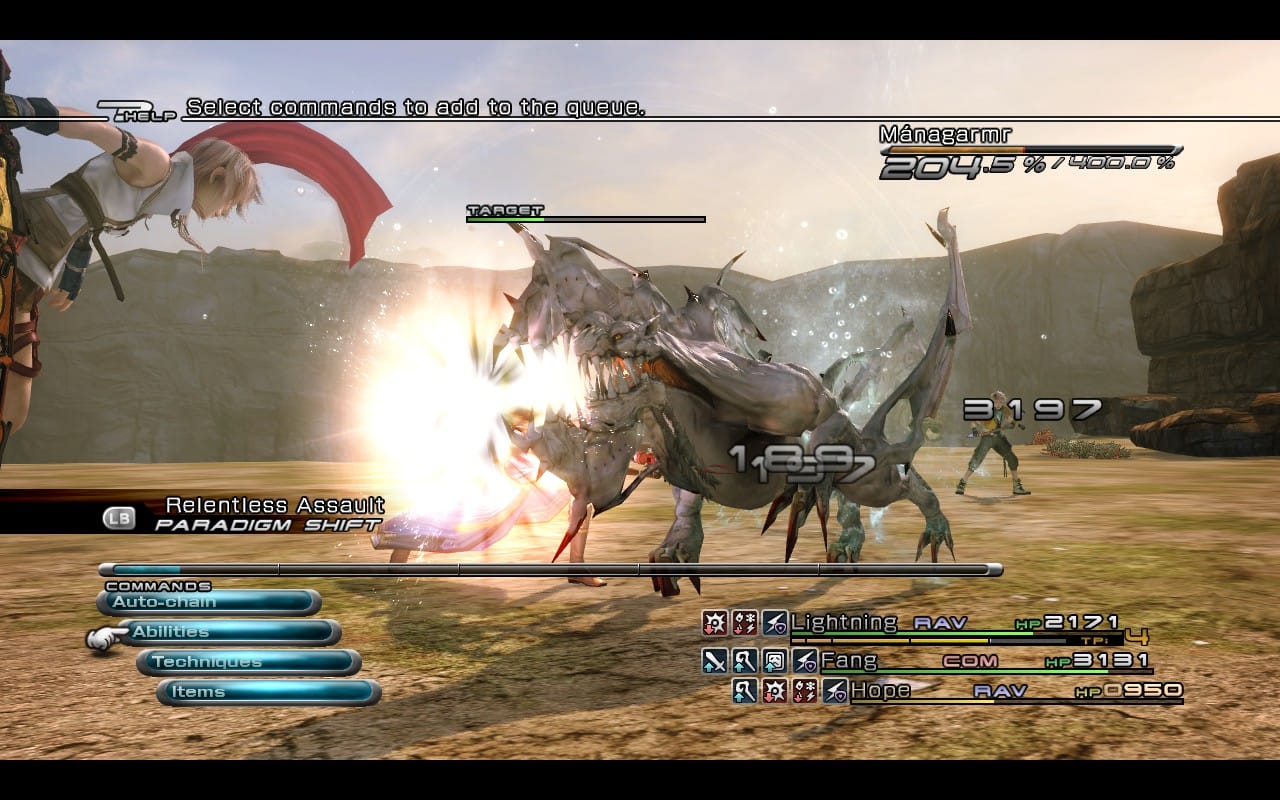
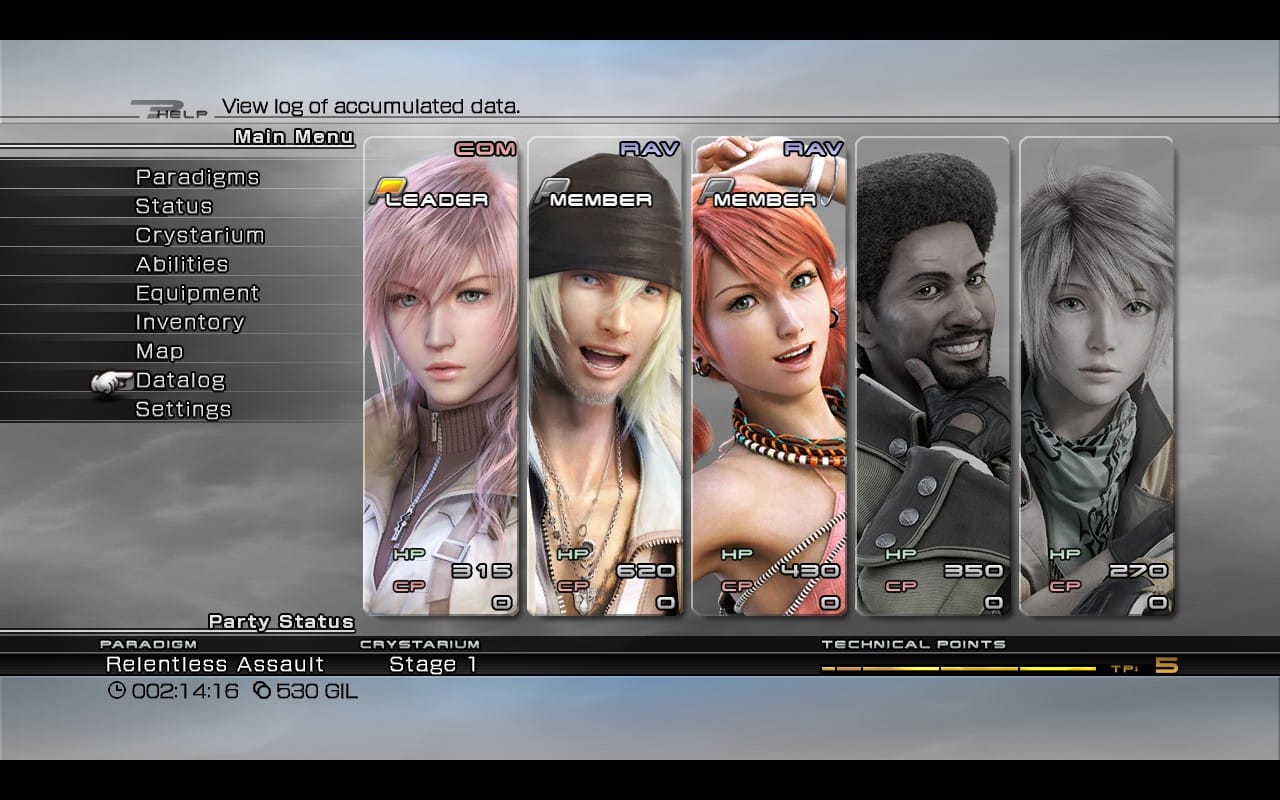
Combat and Menuing in Final Fantasy XIII
Instead, Final Fantasy XIII moves in the direction of speeding up and simplifying the franchise’s traditional turn-based combat. The Command Synergy Battle system, otherwise known as CSB, is one that aesthetically and mechanically can appear quite busy. Party members in Final Fantasy XIII initially have access to 3 main Paradigm Roles: combat classes that can be swapped to on the fly via pre-built configurations called Paradigms.
These combat classes may have fancy names, particularly in the English release which for some reason chose to throw away the Japanese releases very straightforward naming scheme of Attacker, Blaster, Defender, Jammer, Enhancer and Healer. However, although names like Ravager and Saboteur may obscure the purpose of these classes, they all can be summed up pretty simply: Commandos do physical attacks, Ravagers have combat magic, Sentinels are tanks, Saboteurs manage debuffs, Synergists cast party buffs, and Medics are healers. They map onto traditional job class archetypes that should be familiar to people who have played JRPGs.
The core tension of the combat system is really time and party management. Anticipating the flow of combat and switching to an optimal paradigm set is key for getting through combat encounters, particularly in the late game. If your party members’ health bars are getting low, switching to a paradigm shift with even a single medic can be the key to keeping the pressure up and continuing to damage enemies. This is on top of managing the Chain Gauge on enemies, which appears in the top right corner of all combat encounters. The Chain Gauge has a percentage attached to it, which can be increased from 0 to above its max value via keeping up a constant rate of attack and using certain classes to quickly build and then stabilize the gauge. For example, Commandos keep a chain gauge from dropping while Ravagers magic attacks boost the gauge quickly but cannot keep it from decreasing rapidly without assistance from another Paradigm class.
Efficiency and effective management are encouraged via the game’s combat rating system, which gives you a score from 0 to 5 stars at the end of every combat encounter. These scores are determined by a combination of how much damage you dish out and if you complete the combat encounter before a set time target. High scores give players a higher chance at getting rare drops from enemies.
CSB has been criticized in several ways, some of which I agree and disagree with. To start with the pet peeves, particularly back during the heyday of Final Fantasy XIII backlash, many players criticized the combat system for being inflexible, confusing, and boring. Certainly, I can agree with some of the critiques about the inflexibility. The pace at which Final Fantasy XIII teaches its combat system to players is egregious. Rather than introduce a tool kit and let players experiment with what’s available to them, each element central and tertiary to combat like character/weapon customization and leveling is trickled down to the player across the game’s first 18-20 hours. Yes, you read that correctly—not 1-2, not 3-5, 18-20 hours.
The contemporary negative review from Edge magazine sums up these issues rather neatly:
While the [combat] system is complex, it’s not too hard to get to grips with the basics, but you won’t have access to the full capabilities of your party until around 20 hours in. It introduces every element at a crawling pace, and seems to think the only way players learn is through repetition – you’ll get a new tactic and then have to barrel through a series of identical enemies that are defeated by spamming it.
The first 10 chapters all follow the same format, introduce a new gameplay mechanic or two somewhere in the chapter’s runtime, and then force the player to learn it through combat encounters designed to test the player’s understanding of their new skills. This is standard tutorialization in some ways, but the pace at which these tutorials are doled out and the way they are executed is not conducive to an enjoyable or challenging experience. It would be one thing if these mechanics were taught to the player over the course of the first handful of chapters, but instead the first two chapters of Final Fantasy XIII restrict the player to only the most basic combat abilities. Paradigm shifts and the actual meat of the CSB system aren’t truly explored until Chapter 3. New paradigm roles and abilities are then doled out slowly over the following chapters.
In Chapter 4, the game forces you into two party member configurations that teach the player how to effectively utilize the Synergist and Saboteur roles respectively. Again, conceptually, this is fine. Players are placed into a scenario with a limited tool kit and forced to familiarize themselves with it. The problem lies more in the execution. Most of the tutorials explaining these systems are mere PowerPoints of dense text and screenshots. There are a couple interactive tutorials, but these are for the most part few and far between. As such, sometimes the game fails to effectively communicate certain things about its combat system. For example, it wasn’t until this playthrough that I realized Saboteur abilities also slow down the chain gauge. This made the Sazh and Vanille sections, which in prior teenage playthroughs I found to be a brutal slog, much more engaging and fast paced.
What really drags down these initial hours though is the lack of party customization. I understand starting characters off with only 3 paradigm roles, it keeps the tool kit focused and learnable, but the fact you can’t swap party members or party leaders until 20 hours into the game is a decision I can’t understand. I understand splitting up the party into smaller configurations to highlight and teach specific paradigm roles, but why prevent players from choosing which characters they control in combat outside of those initial tutorial encounters? Additionally, when you do finally get the ability to switch out party members, you are still restricted to a party leader until the start of Chapter 10, a rather strange and arbitrary delay of control that I have been unable to deduce the reasons for to this day.
By the time this customizability comes into play, the player has effectively been conditioned into taking whatever the game has handed to them. This is particularly the case with the paradigm classes. The full set of 6 is unlocked for all playable characters at the same time you unlock the ability to switch out party members in Chapter 9. By this point though, characters have specialized in certain classes for so long that many players are likely to feel discouraged from leveling up those new roles. I know on my first playthroughs of the game, I certainly was! The stat upgrades are much smaller in comparison to the characters’ original 3 roles, making them seem like poor, potentially wasteful upgrades to spend your experience points on.
This is shame, because this time around I actually did experiment with leveling up some of these new roles and I found that it made the latter half of the game much more dynamic and engaging. In fact, I’d argue that at every single point in Final Fantasy XIII, the game is more fun and gripping when you make full use of the roles and skills available rather than if you play it safe and stick to what you’ve been taught to use in the opening hours of the game.
On this playthrough, I stuck with my traditional party of Lightning, Fang, and Hope, but leveled up Lightning’s Saboteur class to get access to Poison and leveled up Fang’s Ravager class to gain access to the triple Ravager paradigm set called Tri-Disaster. Focusing on these optional choices ended up filling the gaps that been present in this party’s skill set on previous playthroughs. With access to Poison and Tri-Disaster, I was able to deal higher damage and get enemies to stagger way quicker than on my previous playthroughs. Again, playing with the tool set available to you to maximize the efficiency and quickness of combat rewards players with more engaging experiences. Unfortunately, the intense amount of handholding throughout XIII instead teaches players to not adopt this playful mindset that, in my opinion, is key to making combat encounters near the end of the game not a complete and utter slog.
Where I disagree with critiques about CSB’s restrictiveness is in this regard. Just because the game encourages and rewards a player utilizing a given tool set in a specific way does not mean the combat system is bad. Some combat systems favor player expression—encouraging players to customize their party into new configurations and ability sets at their whim. Some combat systems though, like Final Fantasy XIII, encourage players to play with a tool set in order to maximize it toward a certain end goal. One of these types of combat system is not inherently better than the other, they’re just different.
To be clear, if you prefer one form of RPG combat to the other, that’s fine, but let’s not dismiss Final Fantasy XIII’s combat outright because it encourages speed and high damage output over trying out new and crazy combinations of Paradigms no matter what the combat design is encouraging a player to implement. At its best, the various systems of Final Fantasy XIII create exhilarating combat encounters where players have to constantly juggle between their sets of paradigms to keep damage high, buffs and debuffs active, and most importantly top off party member’s health. Party member deaths ground combat to a halt in this game and that’s intentional. It’s supposed to create friction and risk the player dipping below a five-star battle rating.
Of course, there are certain things that bother me about CSB in this iteration. For one thing, the five star rating system is not as effective an incentive as it could be. While rare drops are nice, most players aren’t going to know what an enemy drops unless they are scouring the enemy’s battle log or looking up things in advance of certain boss encounters. If I were allowed to make edits to the game’s design, I think adding experience point bonuses would go a long way to encouraging the type of play style the game wants to foster.
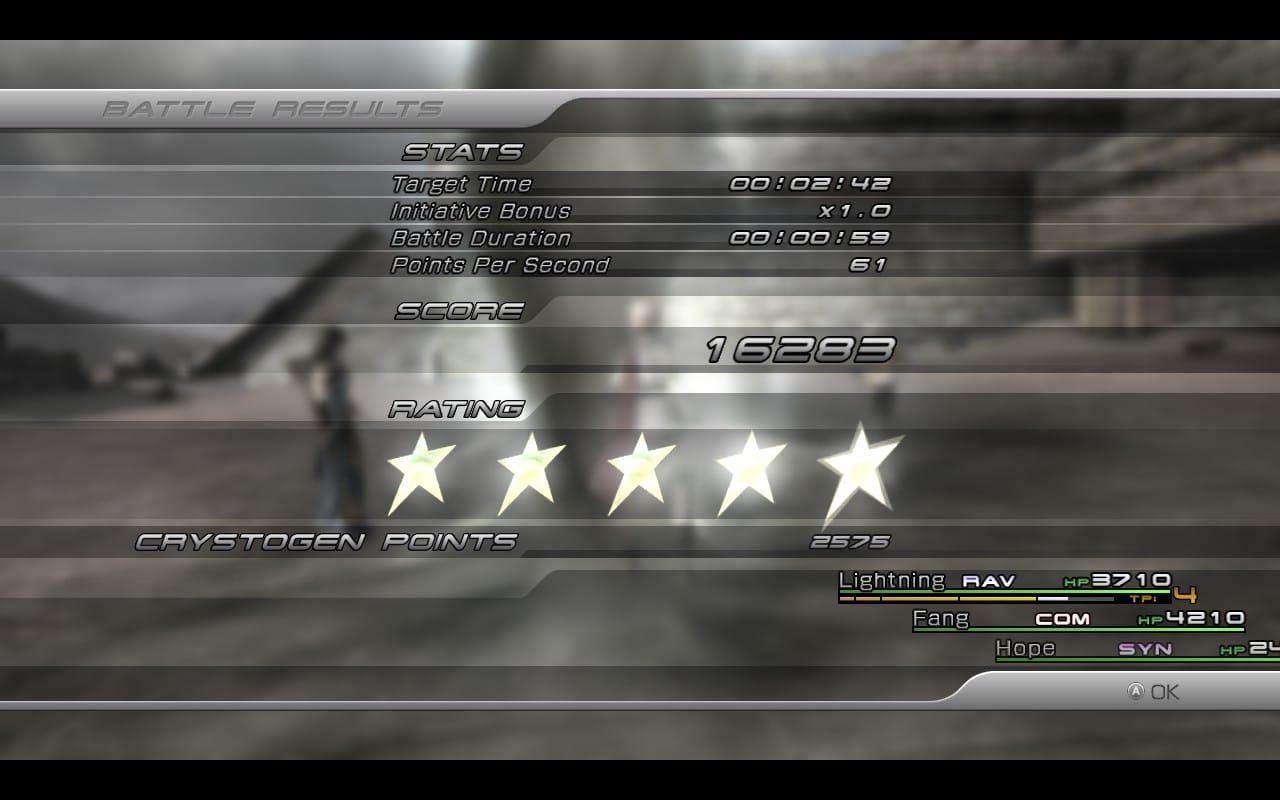
Still, I don’t agree that the star system’s methods of rating are too opaque. In some old YouTube reviews that shall not be named, people would pull out the literal game code and use that as evidence that the star rating system’s methods were indecipherable. Of course, when you pull out the out of context game code, it’s going to look overly complicated! Actually engaging with the combat deeply though will quickly teach players that high damage output in combination with being well under a given target time will result in higher star ratings.
In terms of critiques I do agree with around CSB, I fear I must address the elephant in the room. In the same way that the developers prioritized graphical fidelity over certain traditional JRPG gameplay elements like towns, Final Fantasy XIII’s combat system and the tertiary systems surrounding it often prioritize aesthetics over quality. The big one that most critics point to is the Auto-Battle aspect of CSB. By default, the combat system is set to auto-select the Auto-Battle option in combat encounters. In combat, there is an ability gauge which has segments you can slot spells, attacks, and other abilities in depending on your current paradigm. These can either be input manually by the player by scrolling through a character’s ability menu in combat, or the game can auto-select abilities to fill the gauge for you with the auto-battle option.
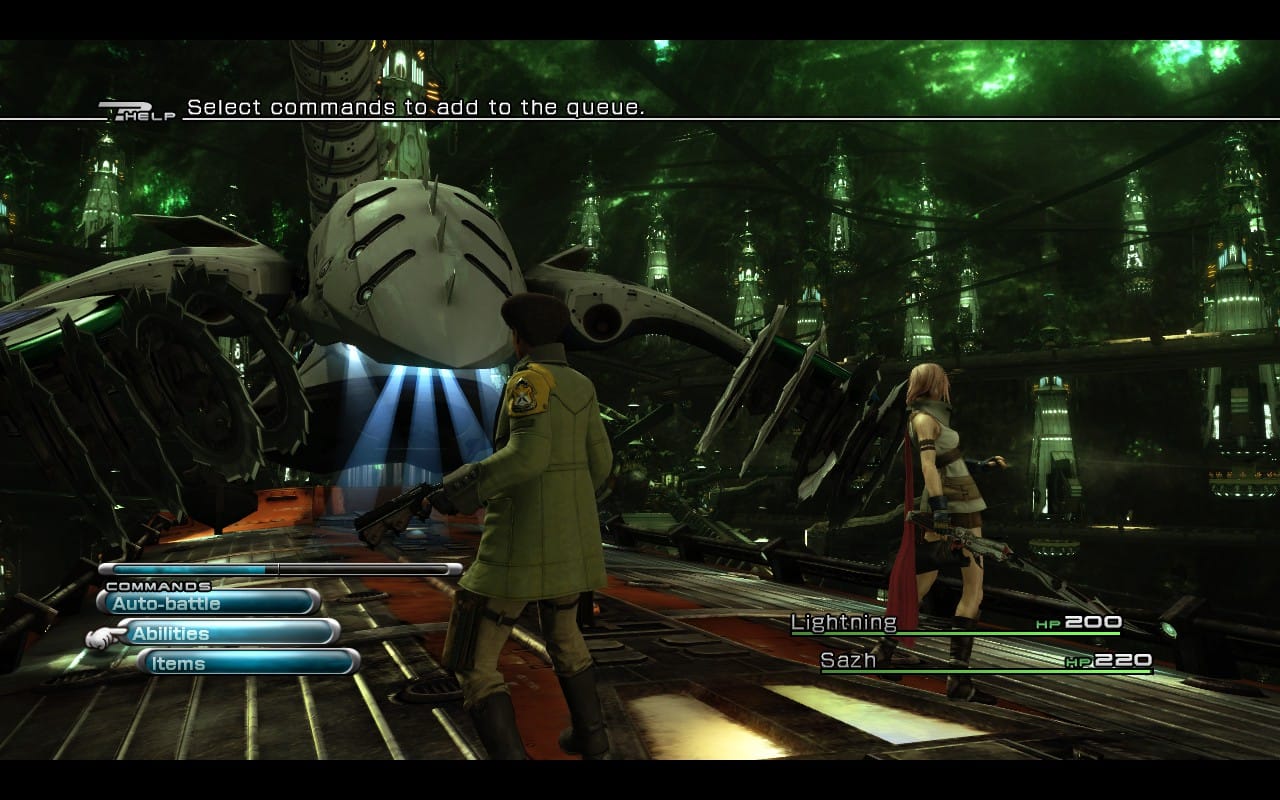
The default settings forcing players to have combat menus set to Auto-Battle by default strikes me as yet another example of the game designers fearing player’s getting confused and frustrated by the combat system. This is in spite of the fact that the game does not give you access to multiple paradigm roles until Chapter 3, around 3 hours into the game proper. There are literally only 3 abilities to select from at max in these opening hours—why did the developers not trust that players could manage that?
In fact, I’d argue that for at least the first 7 chapters of this game, it is relatively easy to manually select one’s abilities in combat. During that section of Final Fantasy XIII, the number of options is not so overwhelming that it feels impossible. Simply scan the enemy with Libra, check for weaknesses and status vulnerabilities, and prioritize those when selecting abilities.
By Chapter 9 though, things start to get more complicated. Not only are all paradigm roles now available for players, but the pace of damage output from enemies and the general speed of combat increases dramatically. This makes manually selecting abilities in the middle of combat feel cumbersome and not worth the effort when Auto-Battle can for the most part give you exactly what you need at any given moment. This is sad, because if you do manually select your abilities early in the game, you will quickly discover that Auto-Battle isn’t actually a perfect predicter of the best moves for any given moment.
Sometimes when enemies are bunched together and a multi-target magic spell would be highly effective, it sticks to single hit abilities and vice versa. But even with this knowledge, the latter half of the game simply makes the process of optimizing via manual selection too challenging for most players. As such, players will end up defaulting to Auto-Battle since that’s what the game has taught them to do in the first place. The result is that some encounters, particularly non-boss encounters, can feel a bit rout after a few repeats of the same formations of monsters.
To me, auto-battle is a symptom of wanting to make the game look cool, fast, and frenetic, rather than prioritizing player engagement with its mechanics. If the developers had slowed down the pace of combat and made selecting abilities manually a default and more viable option in the second half, then I imagine players would better be able to appreciate the time and class management aspects that make the combat system so interesting. Instead, players are once again taught to play the game in a much less interesting way through how it constructs its tutorialization.
Similar aesthetic prioritizations overcomplicate Final Fantasy XIII’s level up system, the Crystarium. The Crystarium is in some ways a retread of the Sphere Grid system of Final Fantasy X. Players collect CP, or Crystogen Points, which act as EXP a player can spend on various stat and ability upgrades. Each paradigm has a different branch, which means that players have to engage in some form of prioritization based on what ability and stat unlocks might be the most useful at any given moment. Claims that the Crystarium is entirely linear and its just pressing X to level up are not entirely accurate as a result, but it’s hard not to agree with these critiques on some level.
Since Final Fantasy XIII already railroads players into 3 specialty roles for each playable character, and the game’s tutorials push certain roles in specific areas so heavily, it’s hard not to wonder why the developers didn’t opt for a more traditional level up system that would unlock abilities in certain areas to maximize their intended level design. After all, they already cap character’s ability to level up paradigms behind story progress, meaning that characters can’t become over leveled. My guess is that when the characters unlock all six roles, this would have created issues, but if you’re going to create such a restrictive upgrade system, then why keep the illusion of customizability?
With the Sphere Grid system, theoretically dedicated players could get rare spheres early in the game and force characters off their predetermined ability and stat pathways. It would be difficult, but that customization was there for those dedicated enough to pursue it. Since Final Fantasy XIII’s tutorialization is so railroaded though, this level of customization obviously wouldn’t work. So instead, the developers created a very flashy level up interface with bright colors and crystalline shapes that in reality offers very little dynamic customization until much later in the game.
Much the same can be said of the weapon upgrade system, which is overly complicated in ways that the game doesn’t really reward effectively. On the surface, the weapon upgrade system appears vast: for the first 3 and a half chapters of the game, players collect materials after each battle until they finally unlock the weapon upgrade system halfway through Chapter 4. The game’s explanation of what these materials do is not great, but essentially organic monster materials give players small weapon EXP gains in exchange for overall EXP multipliers that can be stacked. Meanwhile, mechanical enemy materials give big weapon EXP gains, but will eventually remove any EXP multipliers that are in effect. As such, the most effective way to level up weapons in Final Fantasy XIII is to use organic materials to maximize your EXP multipliers and then use your mechanical materials for massive overall EXP gains.
This complexity is fine on paper, but the game’s linear structure does not reward exploration of it. Due to the linear nature of the game, by the time a player might find a more powerful weapon than the one they started with they’ll have already invested too much in their current weapon’s level ups to consider using the new one with a higher stat ceiling potential. I think in theory this is what the organic EXP multipliers are meant to circumvent, but again the game’s explanations of this are not particularly clear. The result is that most players will probably ignore these mechanics in favor of inefficiently maxing out their weapons of choice however they please.
This is unfortunate because, in typical Final Fantasy XIII fashion, engaging with these upgrade mechanics significantly improves one’s gameplay experience. I’ve seen many critics complain that enemies in the late game are HP sponges, but if you are upgrading your weapons, consistently upkeeping debuffs and buffs, and managing your health, no combat encounter in this game overstays its welcome. I know a lot of these points might sound like me dissing people for playing Final Fantasy XIII incorrectly, but I want to clarify that I don’t think this is any critic or player’s fault. Rather, it’s 100 percent on the designers for creating interesting systems and then proceeding to teach players via handholding tutorialization the worst, most boring ways to utilize their available tool set.
Part III: Characters & Narrative
As the previous two sections of this essay have made clear, Final Fantasy XIII is messy from a design perspective. While I certainly think the negative reception of the game was overblown, I can’t deny that many of the critiques are based on things that are undeniably true about the game’s design or, at the very least, how the game teaches you to engage with said design. Certainly, I’m past the point where I can uncritically glaze the game’s many odd decisions, even if in the context of 2009 gaming design trends and culture I can easily see how the developers ended up where they did.
Really though, with an RPG (and a Japanese RPG no less) gameplay is not the only factor determining a game’s success. There is also story and writing quality to consider. On this front, I feel much more strongly that Final Fantasy XIII has been misjudged. Again, it’s not as if all the complaints levied at the game’s story are invalid or without basis. Certainly, I have a fair share of my own, which I will be delving into. However, particularly when looking at negative reviews from its original English release, there is a certain refusal to engage with the game’s narrative and worldbuilding that strikes me as somewhat obtuse.
We’ll start by going back to that negative Edge magazine review of the game, which for better or worse stinks of the year 2010. Let’s start with the writer’s loaded descriptions of XIII’s two major settings, Cocoon and Gran Pulse:
Cocoon is an inspired setting, its blend of high technology and sky-spanning architecture blessed with a vibrancy and vivid colour that often leaves you open-mouthed. Pulse, though more traditional in its savage-land stylings, still manages to be awesome through the sheer scale of the place, beasts the size of buses idly grazing as feral cats attack a behemoth.
So, “savage-land stylings,” huh? Are we sure we want to word it that way? Seems a bit racially coded, doesn’t it?
I already discussed in the first section how the game’s structure and world design contributes to Cocoon having a rather corporate and claustrophobic atmosphere, whereas Gran Pulse is defined by openness and the wildness of nature. To some extent, the writer is tapping into the negative undercurrents of this dichotomy. Gran Pulse does seem to curb a lot of its visual design, particularly for its human cultures, from South Asia, Oceania, and Indigenous cultures. Fang wears a sari and it is revealed later in the game that residents of Vanille and Fang’s hometown of Oerba lived communally via sharing property and resources with each other. Fang and Vanille themselves have names whose structure first delineates their place of origin and then their given name: Oerba Yun Fang and Oerba Dia Vanille respectively.
However, describing these visual design aspects as being “savage-land stylings” is ignoring the text of the game, which goes out of its way to try to highlight that Cocoon’s idea of Pulse as a wild, untamed, and dangerous lower world are not entirely all they are cracked up to be. At several points in the game, Fang and Vanille call out their fellow party members over their biased, negative attitudes toward Pulse. These attitudes are then shown to be cultivated via state media and religion that propagandizes the Cocoon vs. Pulse dynamic.
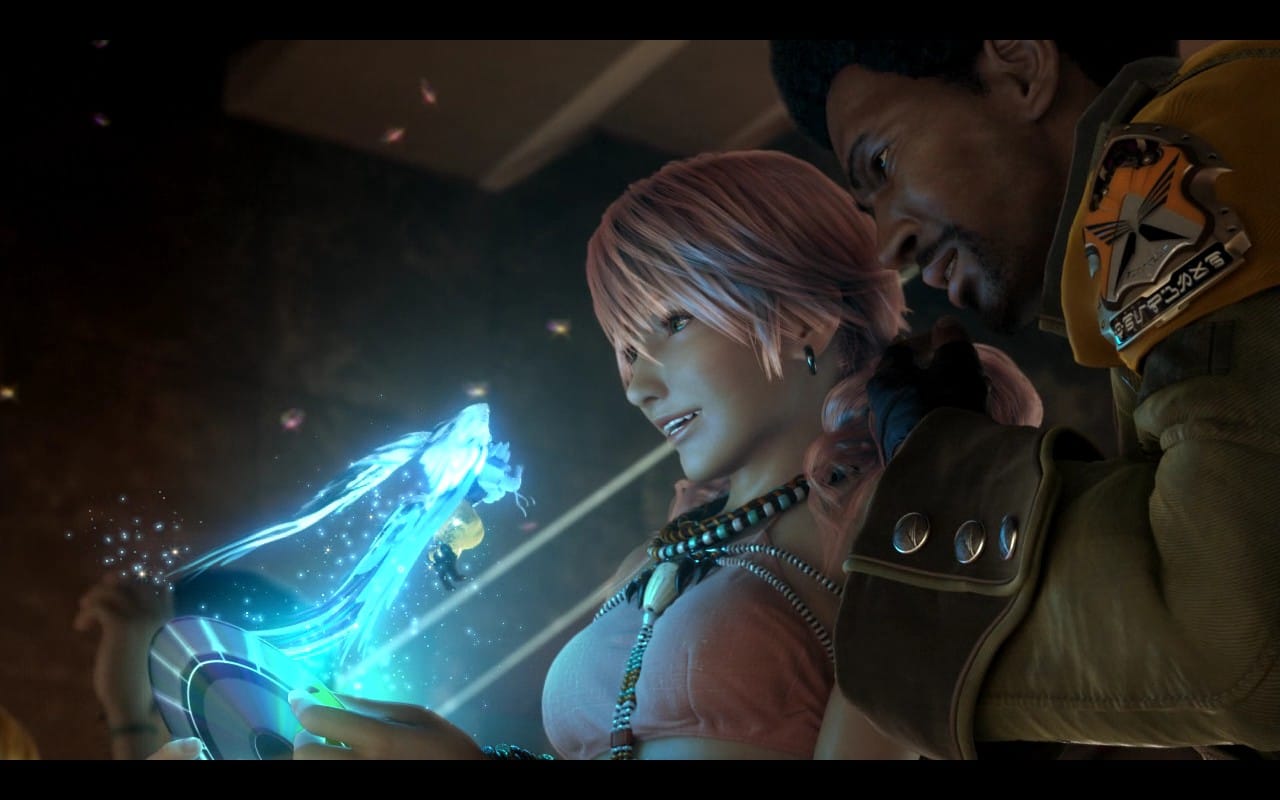
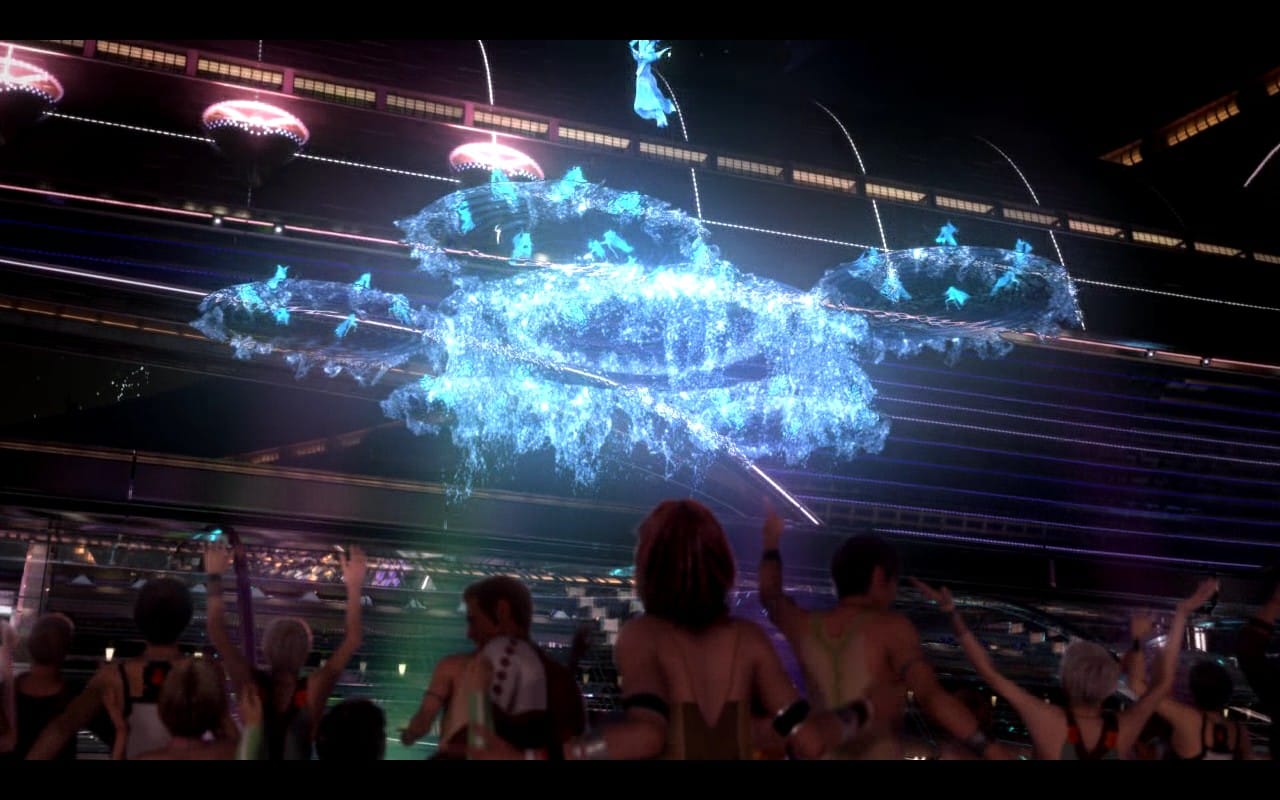
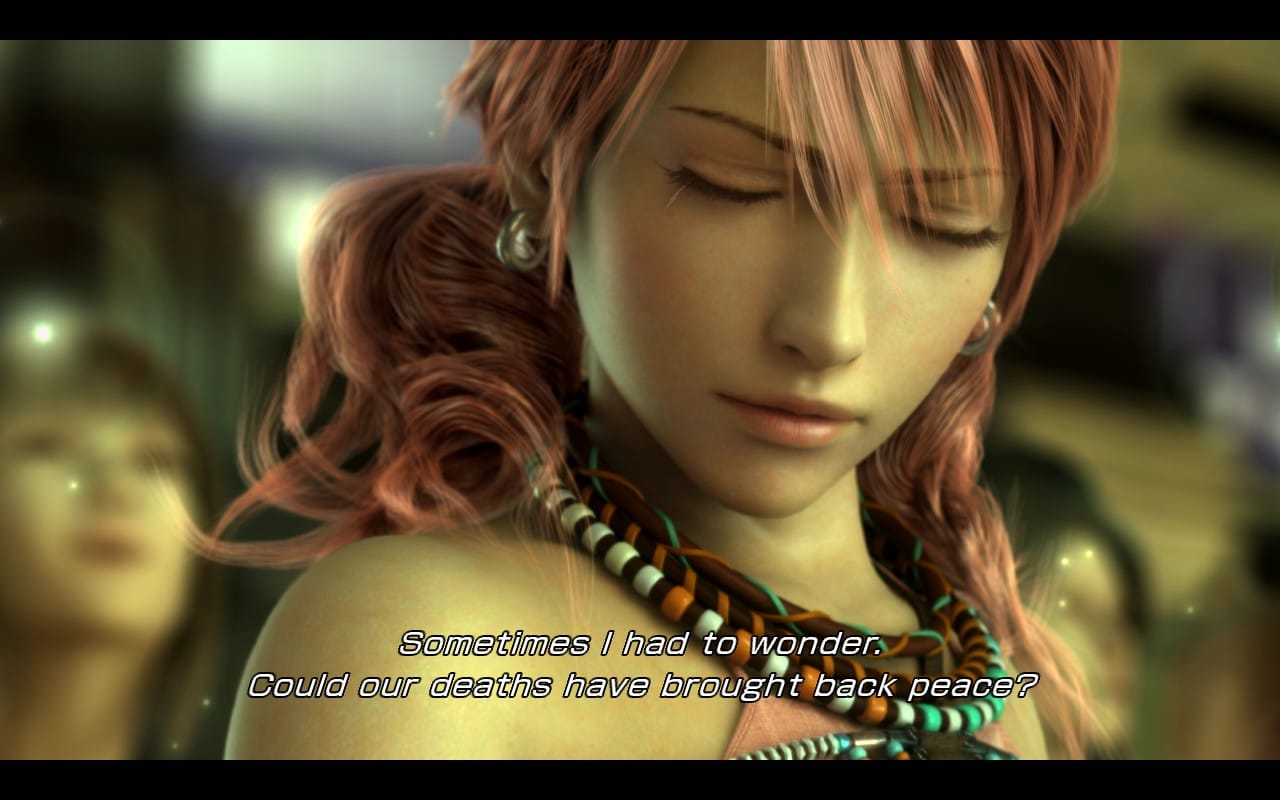
Pompta Santca Parade in Chapter 8
When Cocoon’s hyper capitalist society is broadcasting an attempted capture and execution of fugitives on live television as shown at the beginning of Chapter 7, it might be worth questioning the portrayal of Pulse presented in the early hours of the narrative. Or how about when in Nautilus, the Disneyland-esque amusement park Sazh and Vanille visit in Chapter 8, there’s a cartoony hologram light show dedicated to reinforcing a negative narrative about Pulse to an audience of parents and children? I guess the reviewer for Edge magazine was a bit too in awe of the bright colors and spectacle to pick up on the social implications of these moments.
Much like Final Fantasy XIII emulates Call of Duty’s post-9/11 FPS game design, the game’s narrative picks up some of that franchise’s aesthetic and narrative interest in the War on Terror of the aughts. The catalyst for the game’s conflict—the forced expulsion of innocent civilians who encountered the Pulse fal’cie in Bodhum—calls to mind the targeting and harassment of Muslim civilians in North America and Europe post 9/11. In general, the military technology of the setting, the atmosphere of religious and terrorist fueled paranoia among Cocoon’s civilian population, and the very us-vs.-them framing of the conflict with Pulse as portrayed by Cocoon’s government call to mind the George W. Bush administration with its fear and war-mongering approach to foreign policy and immigration.
Admittedly, Final Fantasy XIII doesn’t fully land this Cocoon as American Post 9/11 allegory. Mostly because the subversion Gran Pulse’s negative image isn’t well executed. Once the characters do arrive on Gran Pulse, they never run into any living human settlements. It’s implied via the Cieth stone missions and the party’s visit to Oerba that in the years following the war with Cocoon, the fal’cie turned too many people into l’cie resulting in the depopulation and decimation of human communities. However, the game could be more explicit in making these points. It shouldn’t necessarily be on the player of the game to engage in side-content to understand that Pulse is not inherently more uncivilized than Cocoon.
In fact, the remnants of past human civilization shown are evidence to the contrary. There were once Cocoon-style urban cities on Pulse like the Paddraean Archaeopolis. Oerba, Vanille and Fang’s hometown, was clearly once a bustling port with a highway connecting it to other places. Yet, the game never really takes the time to acknowledge these visual elements or really leave an appropriate amount of room for our Pulsian characters Vanille and Fang to process what has been lost in the time since they first completed their Focuses. It’s clear they are affected by the sight of Oerba decimated, but outside of their initial comments and reading a Cieth stone that reveals what happened to their home, we don’t get to hear their full thoughts on the state of things. There is an optional side quest to repair a robot companion from Vanille’s childhood and some flavor text accompanying various sights in the decaying village, but that’s it as far as additional gameplay context goes. It’s a shame too, because Oerba is one of the most memorable locations in the game. On the level of visual design and atmosphere, it is beautiful yet eerie.
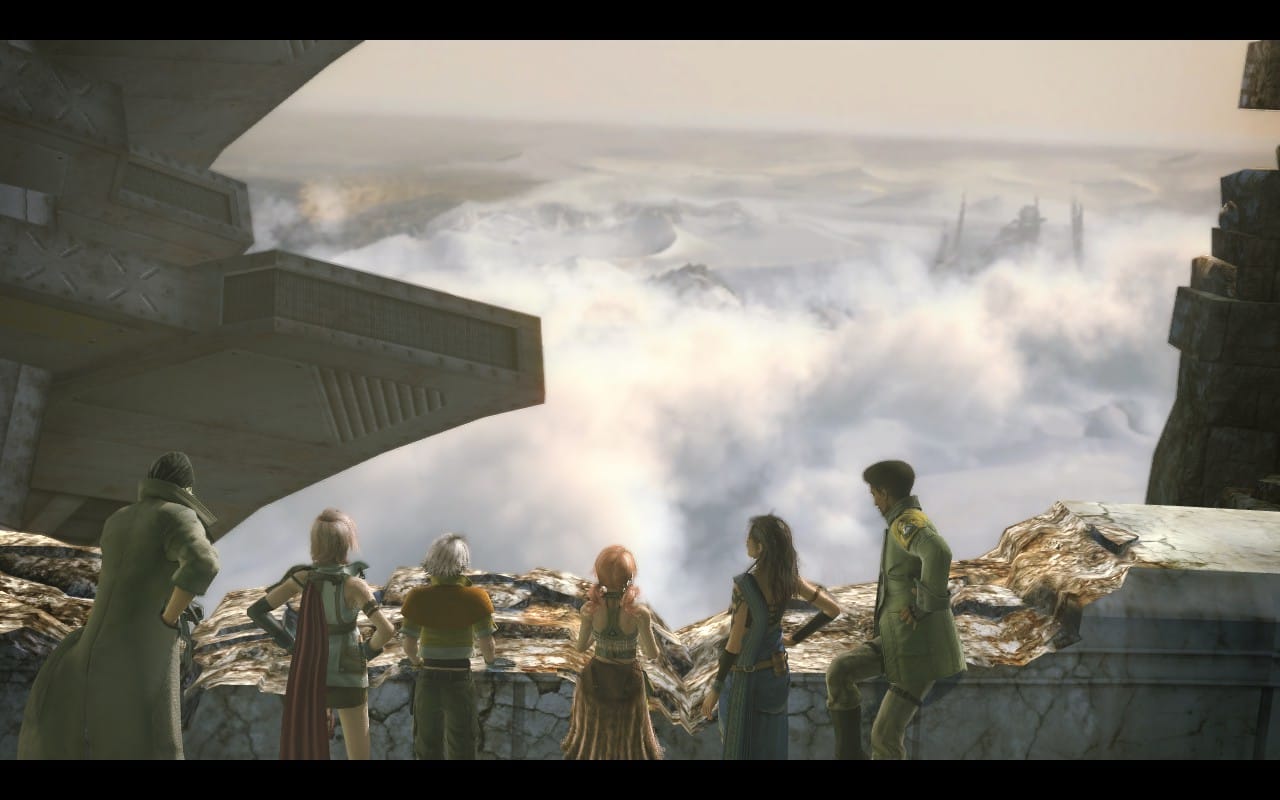
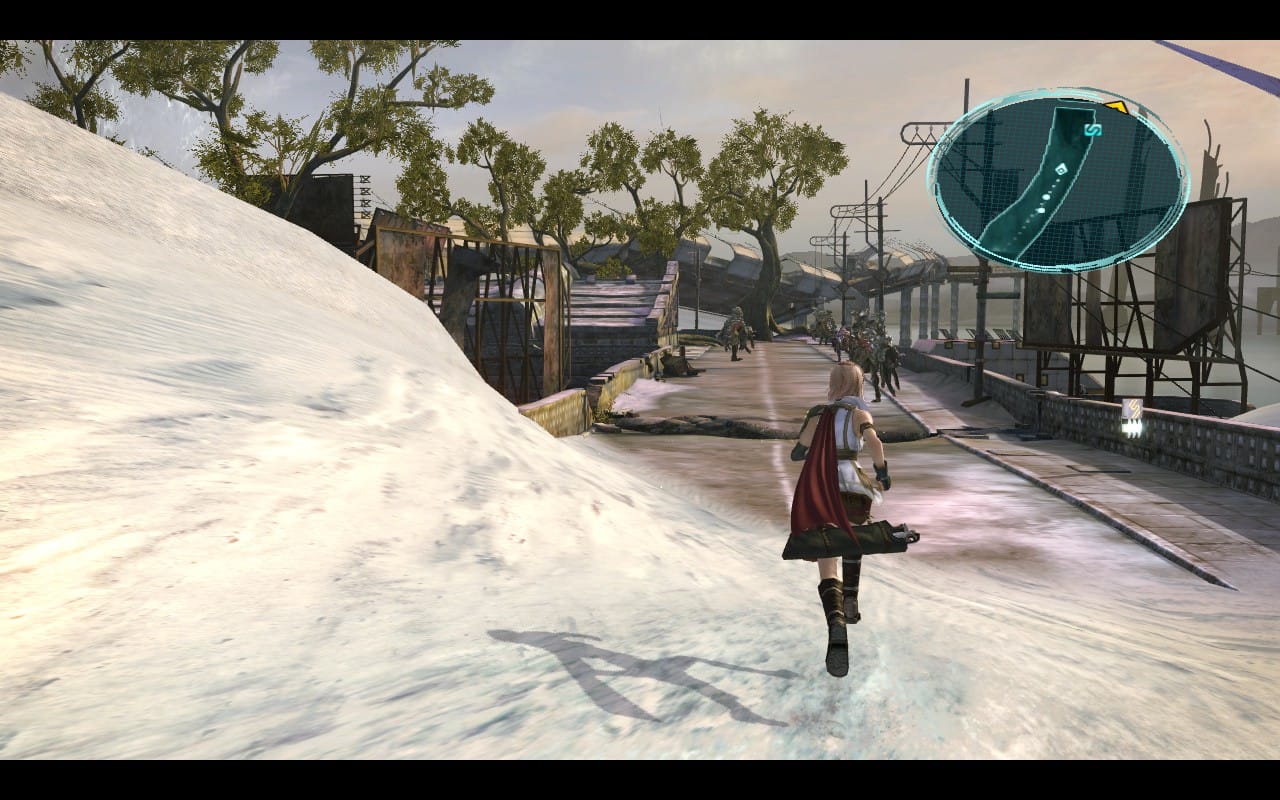
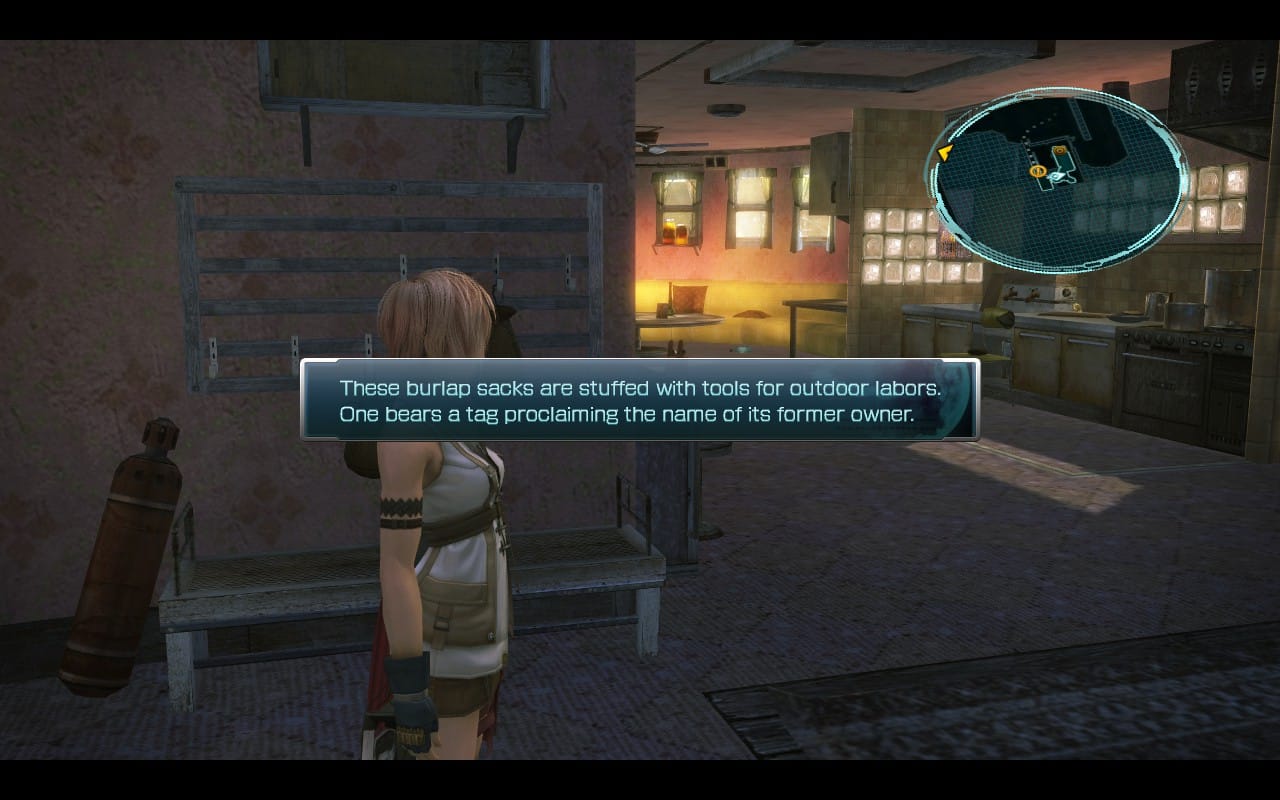
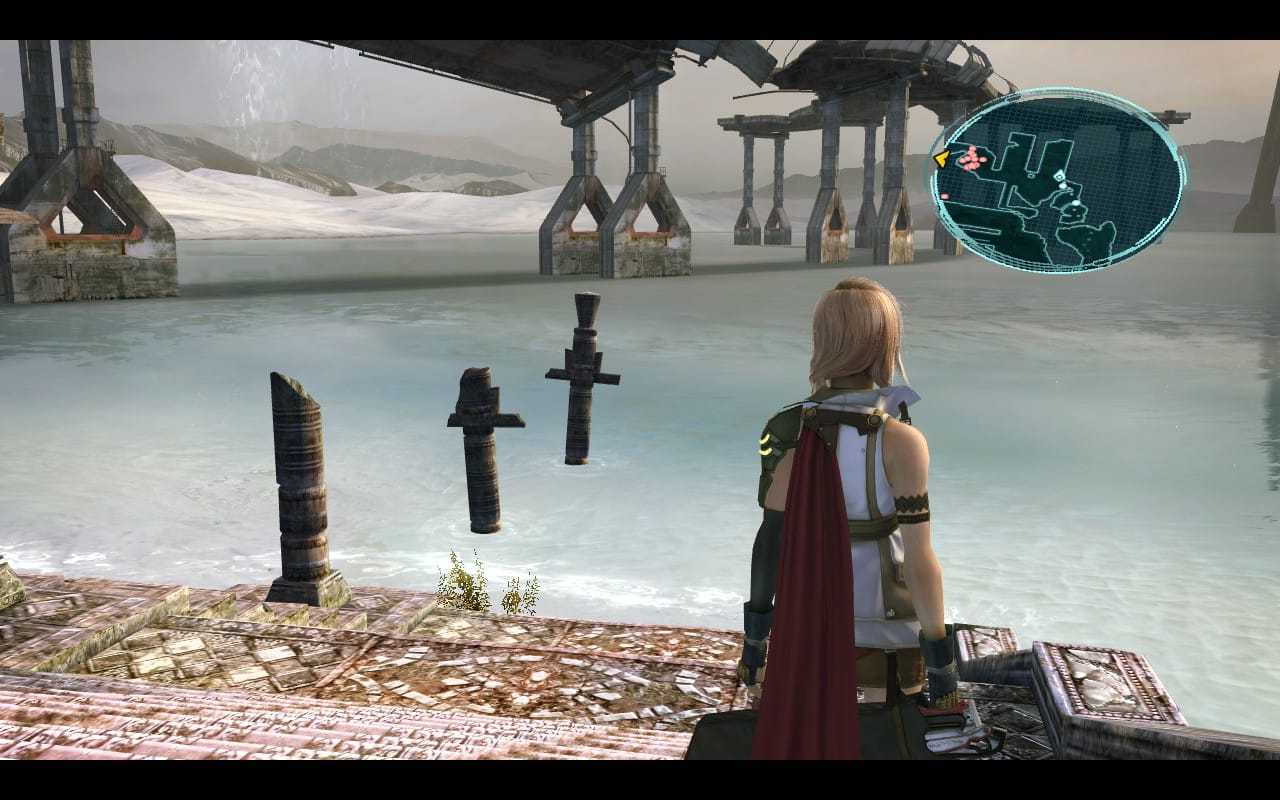
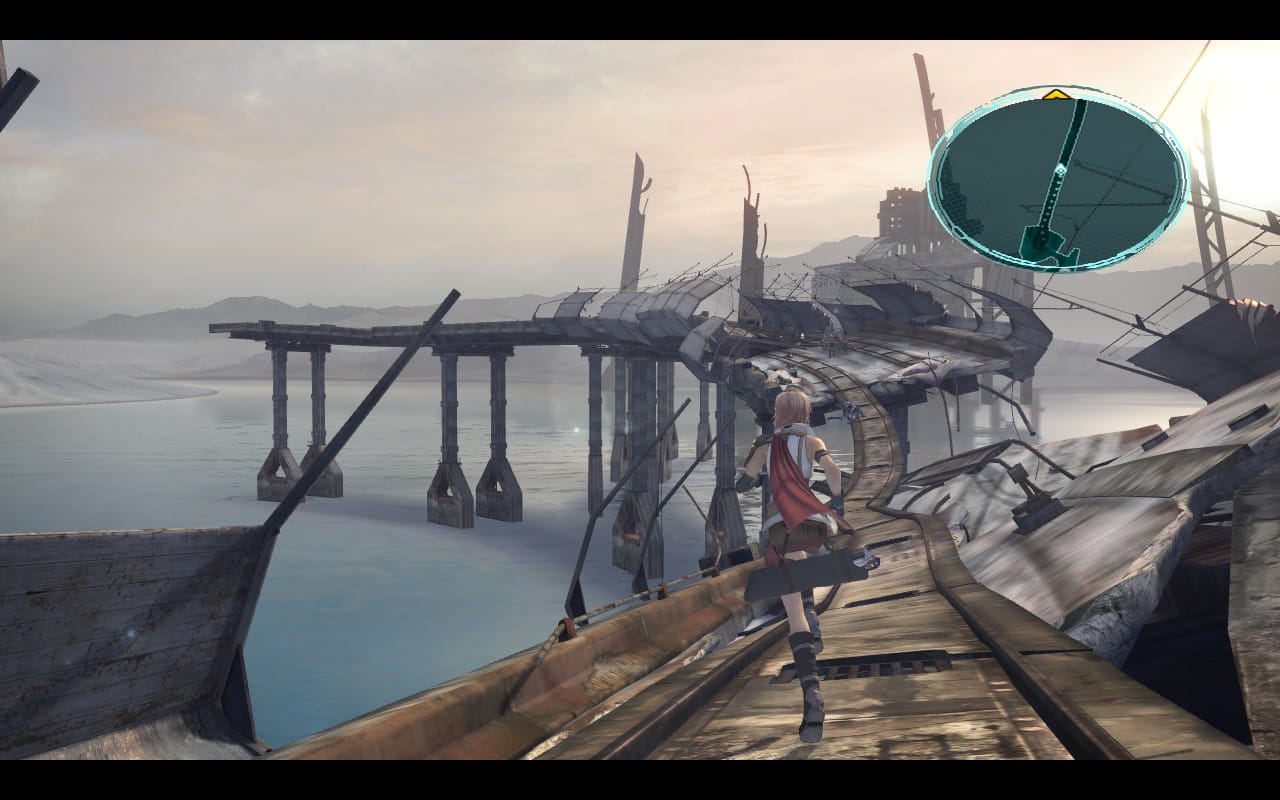
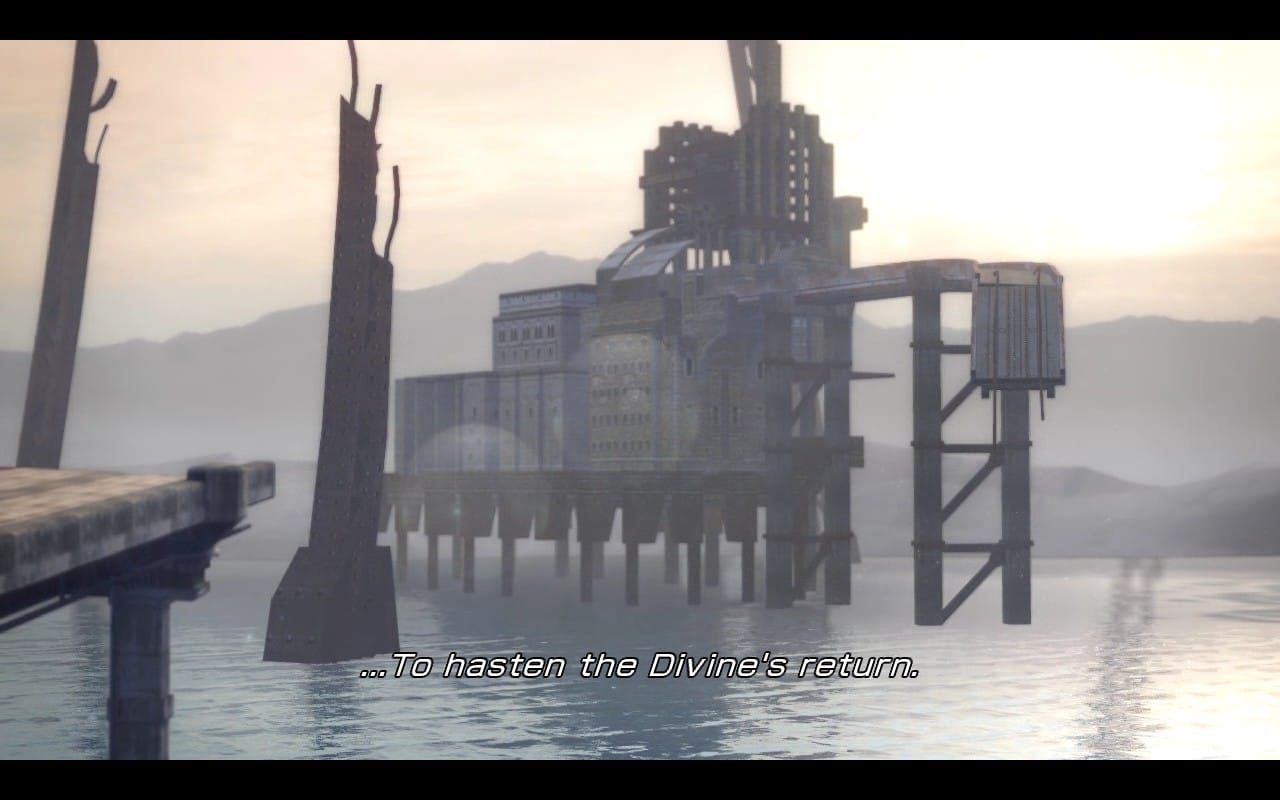
Images of Oerba
The party first spot Oerba from a distance after months of searching for any potential human settlements. Vanille and Fang initially avoided going to Oerba out of fear of it being devastated like the other settlements found during their search, but they maintain hope that it might still be alive and well. In this moment though, those hopes crumble. The town they spot is a rusty and empty place covered in white crystal dust that falls down from Cocoon. When players finally get to walk into Oerba, there is a long pathway leading up to it, allowing one to process their desolate surroundings that open into the decrepit village overrun by Cieth. The crystal dust, white and snow-like, takes on an eerie context in the face of the devastation. In some ways, it’s like ashes scattered on the place the dead used to live.
These arresting images are then paired with one of the best songs from the game’s soundtrack: Dust to Dust, a choral piece sung by the composer Masashi Hamazau’s wife. It’s an intensely melancholic piece, almost a wail of lament at the home Vanille and Fang once had. The melancholic quality of the track is only enhanced by the fact that it does not loop in the way most video game music does. Rather than looping seamlessly, the track comes to a definitive end before starting back up again from the beginning. The result is that there will be times wandering through Oerba that the player is left in silence: the only sounds remaining being the player character’s feet crunching across the crystal dust and the echoey, distorted cries of the Cieth inhabiting the location. It’s sad then that the writing doesn’t quite capture the same overwhelming sense of dread and melancholy that the soundtrack and visuals do.
In general, Chapter 10 onward, when the core party transitions from their escapades as fugitives on Cocoon to the more open world gameplay and story structure of Pulse, is where the writing of this game starts to weaken. This would make some sense considering what we already know about the hectic development of the game and the desire not to drag on development. These last four chapters (10-13) are easily the most underbaked and contain the longest stretches of gameplay without story cut scenes. Many of the developments that do occur in these chapters are marked by a feeling of being rushed or not properly built up to.
To illustrate this though, I first must outline the game’s narrative strengths across its first nine chapters. One thing that Final Fantasy XIII has a strong baseline for is character development and conflict. At the time of release, many criticized the cast of the game as being unlikable and difficult to root for. Going back to the Edge magazine review, the staff writer states:
Hope (really) is a kid tormented by the death of his mother. Vanille’s an over-sexualised nonentity. Sazh is a convincing argument against Danny Glover and Lionel Richie ever again being combined into a single character. The biggest problem is that there’s simply no one else. Outside of the main party, every single character in this game is either a cackling cipher, a bystander with a few repeated lines, or a deus ex machina who’s there and gone within the space of a cutscene.
Where to even begin with this passage? To start, the parenthetical aside after Hope’s name is rather unnecessary. Yes, Hope has a very on the noise name connected to his character arc of overcoming his grief and desire to enact revenge on Snow—the man he holds responsible for his mom’s death. The same thing could be said though of many Final Fantasy character names of the past. In Final Fantasy VI, Terra has a mystical connection of the magical life force of her planet (really) and Locke is literal thief (really).
Skipping forward a little, the writer’s comments about Sazh are once again racially coded. Sazh is THE major black character in Final Fantasy XIII, so who does the writer compare him to? Why Danny Glover and Lionel Richie, of course! I can understand the Danny Glover comparison in the sense that Glover also played a gun wielding father figure in Lethal Weapon, but that is still such a superficial comparison. If anything, if you engage with Sazh in the context of the Final Fantasy franchise, Sazh is more like a slightly more culturally sensitive take on the gruff and tough father figure that is Barret from Final Fantasy VII. But no, instead we have this reviewer pulling two famous black male celebrities he can recall out of a hat to describe a character whose arc is about dealing with the inner turmoil of a father who feels like he has failed his child.
Sazh is by no means a perfect example of black representation. After all, for the opening few hours he acts primarily as a comedic contrast to the cold protagonist, Lightning. Plus, the choice to have a baby chocobo live in his afro recalls racial stereotypes surrounding black people’s hairstyles in old minstrel cartoons. Still, the writers’ attempts to create a black male parental figure who struggles with feelings of inadequacy around fatherhood is compelling and occasionally quite well done. Considering black fathers in media are often portrayed as absentee parents, I can see the writers’ intention for a subversion of and reckoning with that negative stereotype. Sazh takes on a parental role for Vanille, not knowing her and Fang’s presence near a Cocoon fal’cie inadvertently resulted in his son becoming a Cocoon l’cie. There are some good dramatic moments there as Vanille eventually realizes their connection and confesses her feelings of guilt to Sazh. The confrontation between the two leads to Sazh reckoning with his failure to protect his son, resulting in the awakening of his Eidolon. But sure, call him “Danny Glover and Lionel Richie combined into a single character,” I guess!
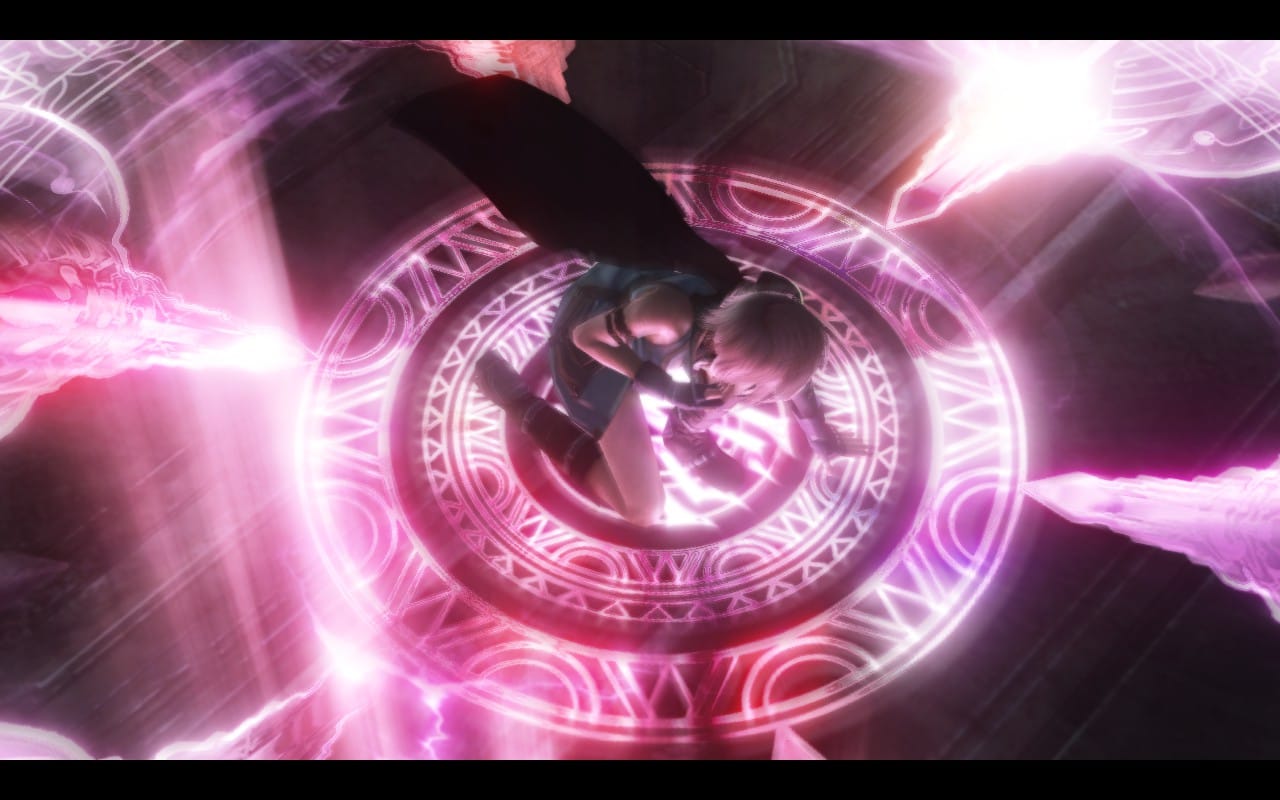
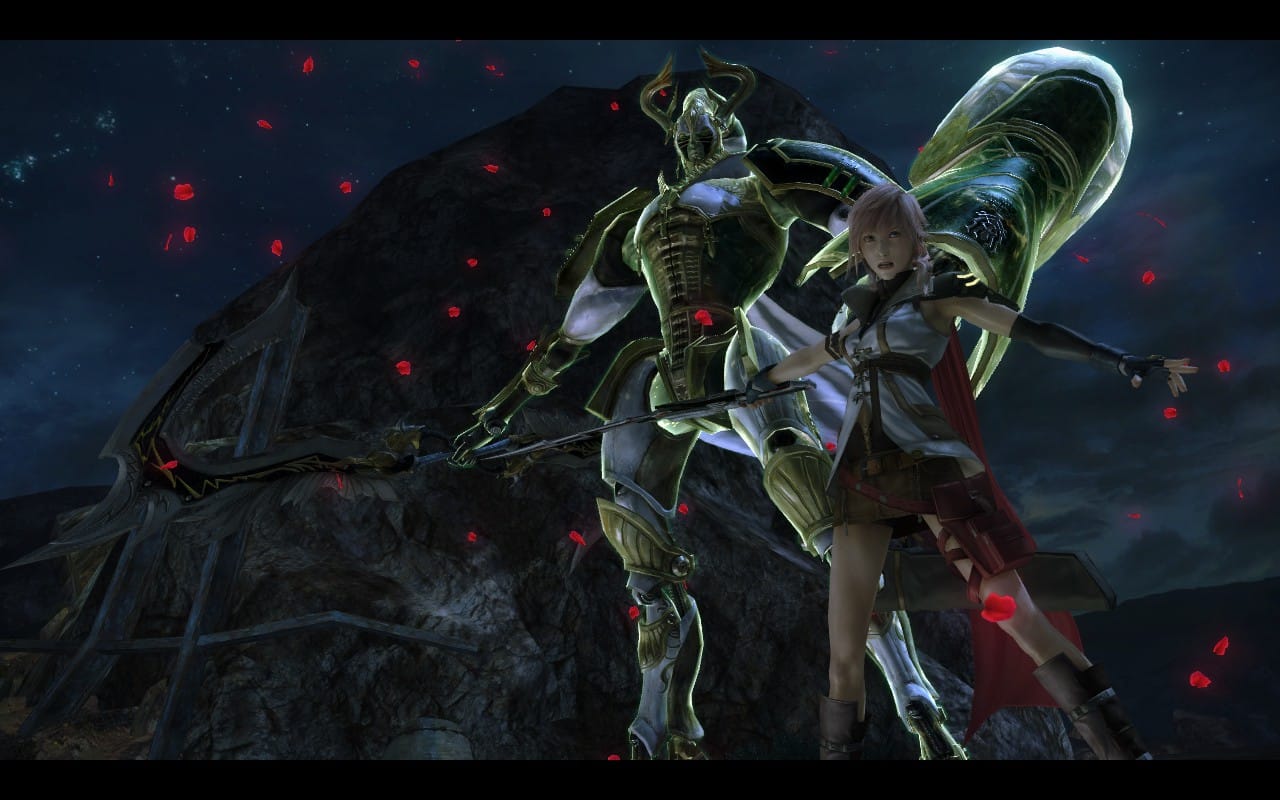
Lightning's Eidolon Awakening in Chapter 4
Speaking of Eidolons, the Eidolon fights in the game are generally some of my favorite narrative moments in Final Fantasy XIII’s first nine chapters. They are a prime example of how the game’s linearity can be used to build a sense of escalating tension that then climaxes in big operatic moments of conflict. For example, with Lightning’s Eidolon fight, throughout the previous sections of chapter 4, the game has been building tension between Hope and Lightning. Lightning, blind with rage and grief in the aftermath being turned into a l’cie and seeing her sister Serah turned into crystal, is desperate to barrel forward and attack the Sanctum in a brazen, suicidal revenge mission.
This is paralleled with Hope’s aforementioned quest for revenge. Hope, in his desire to kill Snow, leans on Lightning for support and guidance. He sees her drive and military experience as an opportunity for him to learn and grow as fighter. Lightning does not see things this way and becomes frustrated at having to take care of this frail and grieving child. This conflict climaxes with the awakening of her Eidolon, which is summoned by her rage toward Hope. In the following combat encounter, players are forced to protect Hope from the Eidolon by juggling between Lightning’s offensive roles and her new paradigm role of Medic. It’s a wonderful synergy of narrative and gameplay that was only made possible by the tight, linear structure of the previous hours of the game.
The Eidolon fights of chapters 10 through 13 then act as a good contrast to show how the writing of the game in its final half falters by comparison. Unlike the fights for Snow, Lightning, and Sazh, the other 3 party members’ Eidolon battles are poorly built up to. The cutscenes pre-empting them do their best to try to establish why these awakenings are occurring. Compared to the tension building between Lightning and Hope in Chapter 4 though, these supposedly cathartic moments end up coming across as narratively perfunctory; check boxes hit for the sake of gameplay rather than compelling character conflict.
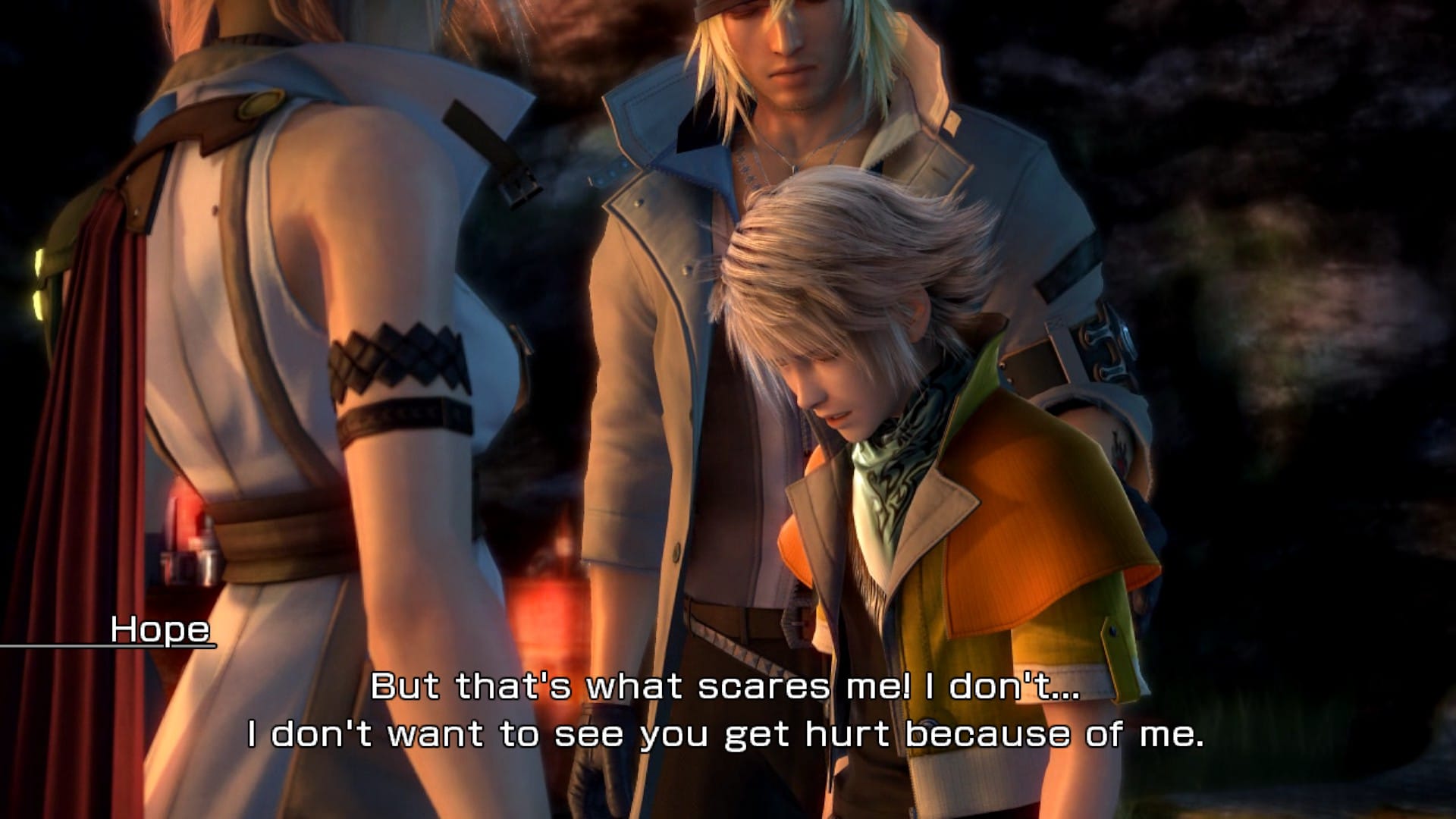
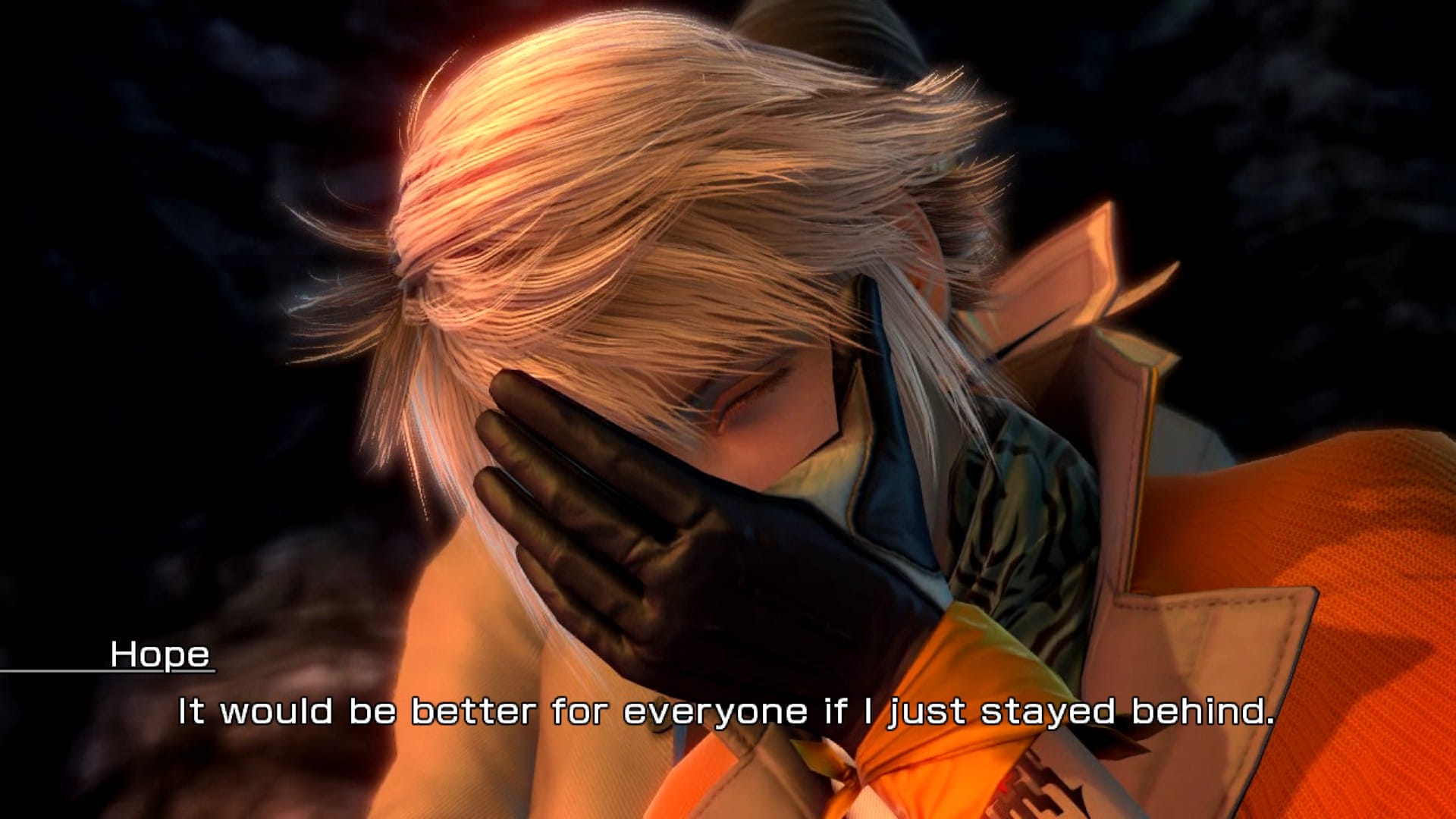
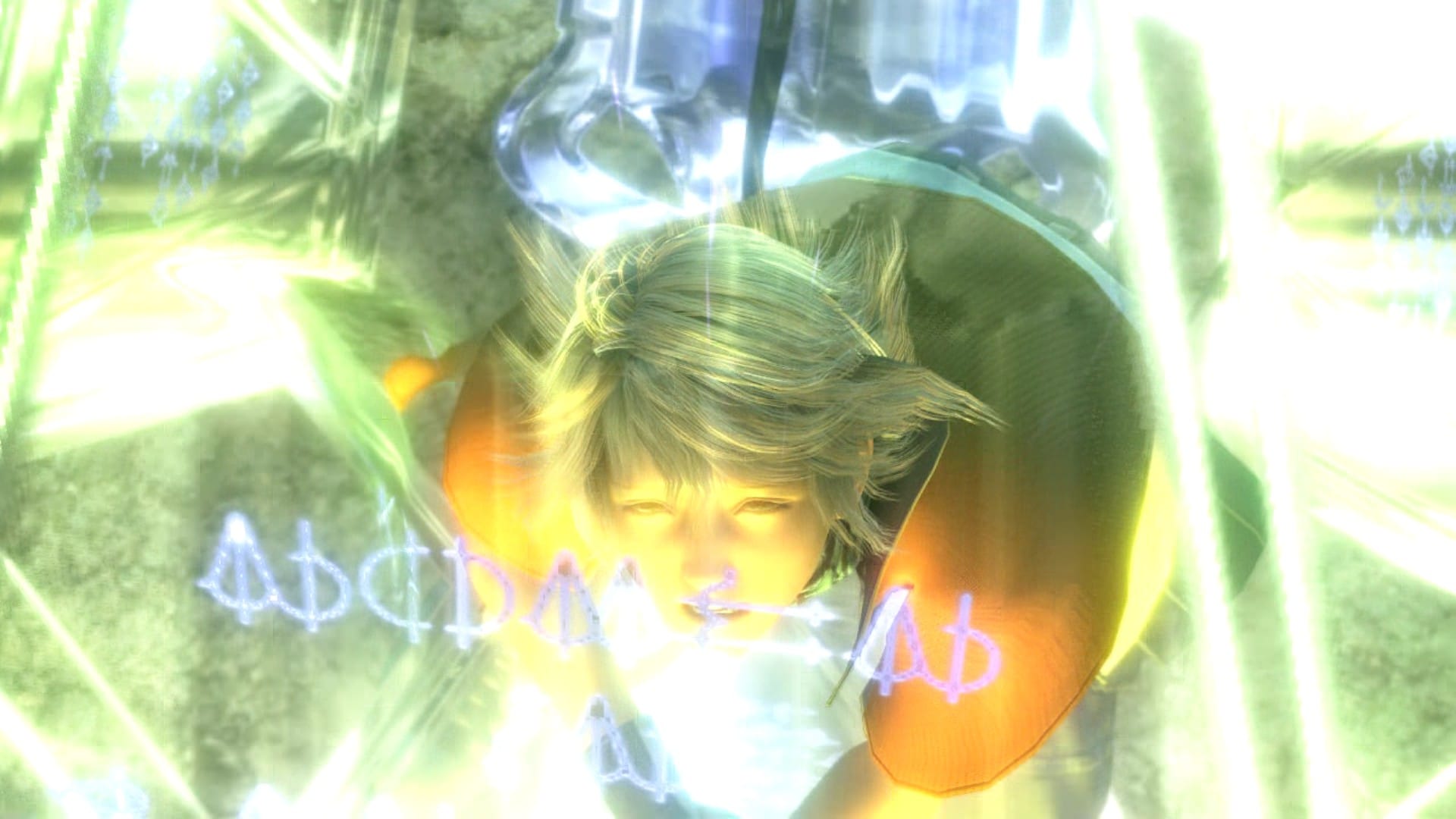
Screenshot from Hope's Eidolon Awakening
Hope is a good case study here, because there is a narrative moment in Chapter 7 that would be perfect for one of these Eidolon battles. The previous two Eidolon fights up to that point all establish that Eidolons are awakened in moments of intense conflict or personal strife. Hope, who has been wanting to kill Snow for the past 10-15 hours of this video game, is presented in the middle of Chapter 7 with a moment to fulfill his revenge with Snow hanging off a ledge in the aftermath of a confrontation between them. Here one might think his Eidolon would be summoned to attack Snow in the same way Lightning’s was summoned via her frustration with Hope a couple chapters ago. Instead, a missile gets launched at them and Snow shields Hope as the two of them fall several stories to the ground below.
It’s a fine progression of these two characters’ conflict in the moment, perfectly functional on paper, but in the long run this makes Hope’s future Eidolon awakening positively disorienting. Instead of it being the result of his inner desire for revenge coming into conflict with the reality that Snow is not responsible for his mother’s death, in Chapter 11 Hope laments that he isn’t strong enough to fight alongside the other party members. This conflict might have made sense 10 hours ago before Hope blew up an entire military airship with Lightning and Fang, but by this point in the narrative these concerns come across as positively old hat. The moment that prompts this conflict is also quite forced with Hope collapsing after going out to search Pulse on his own unprompted by any other party member.
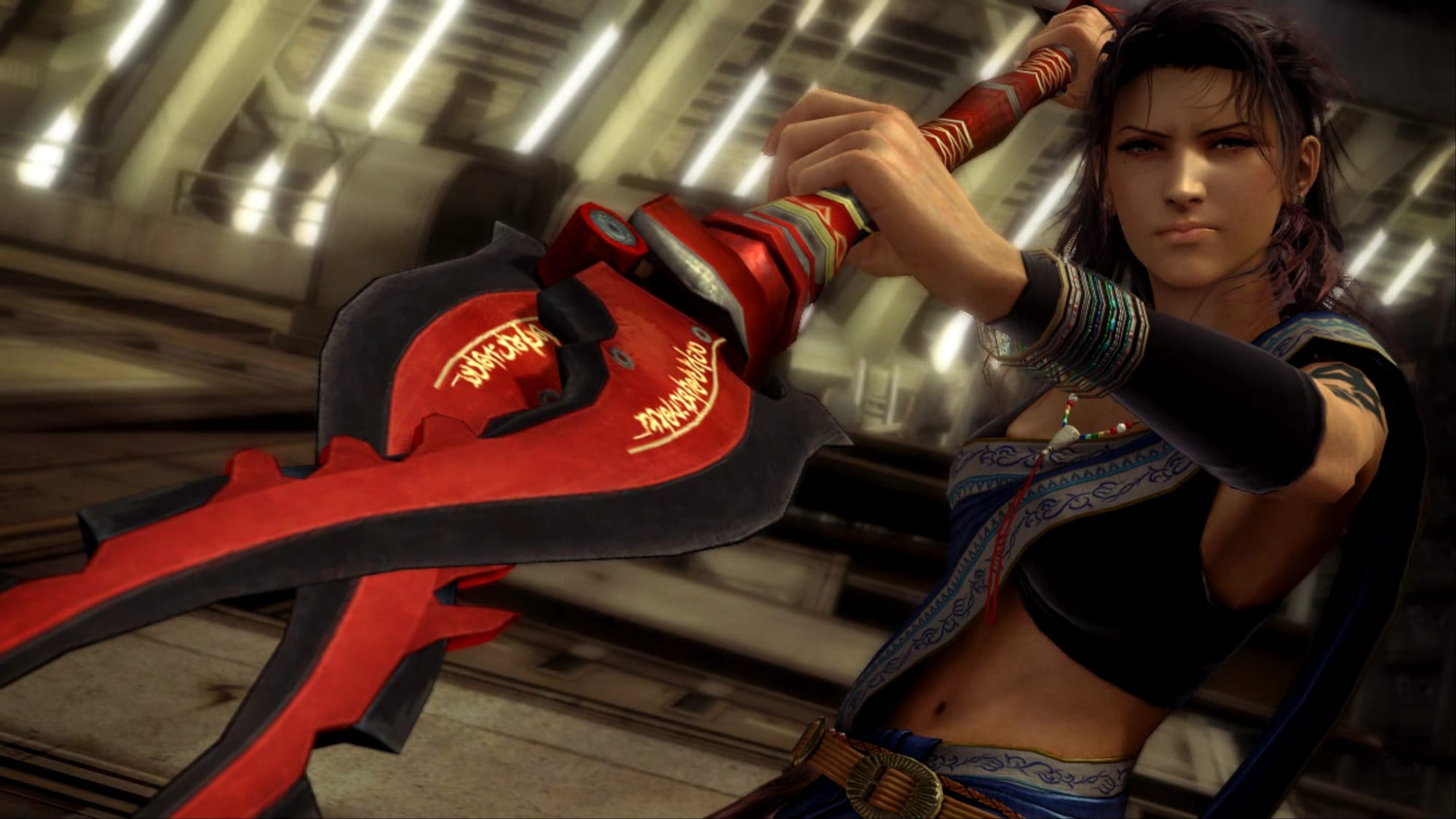
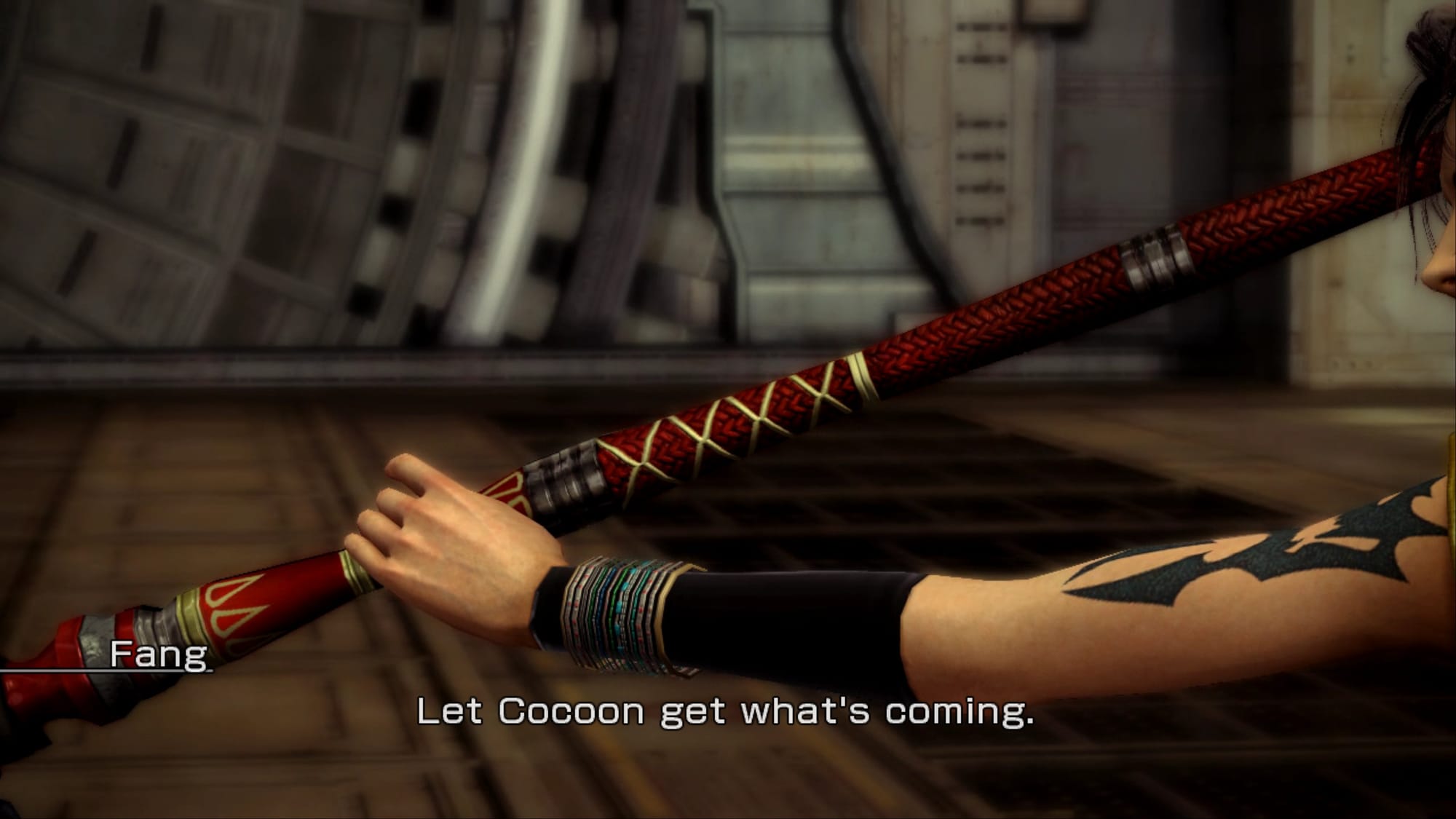
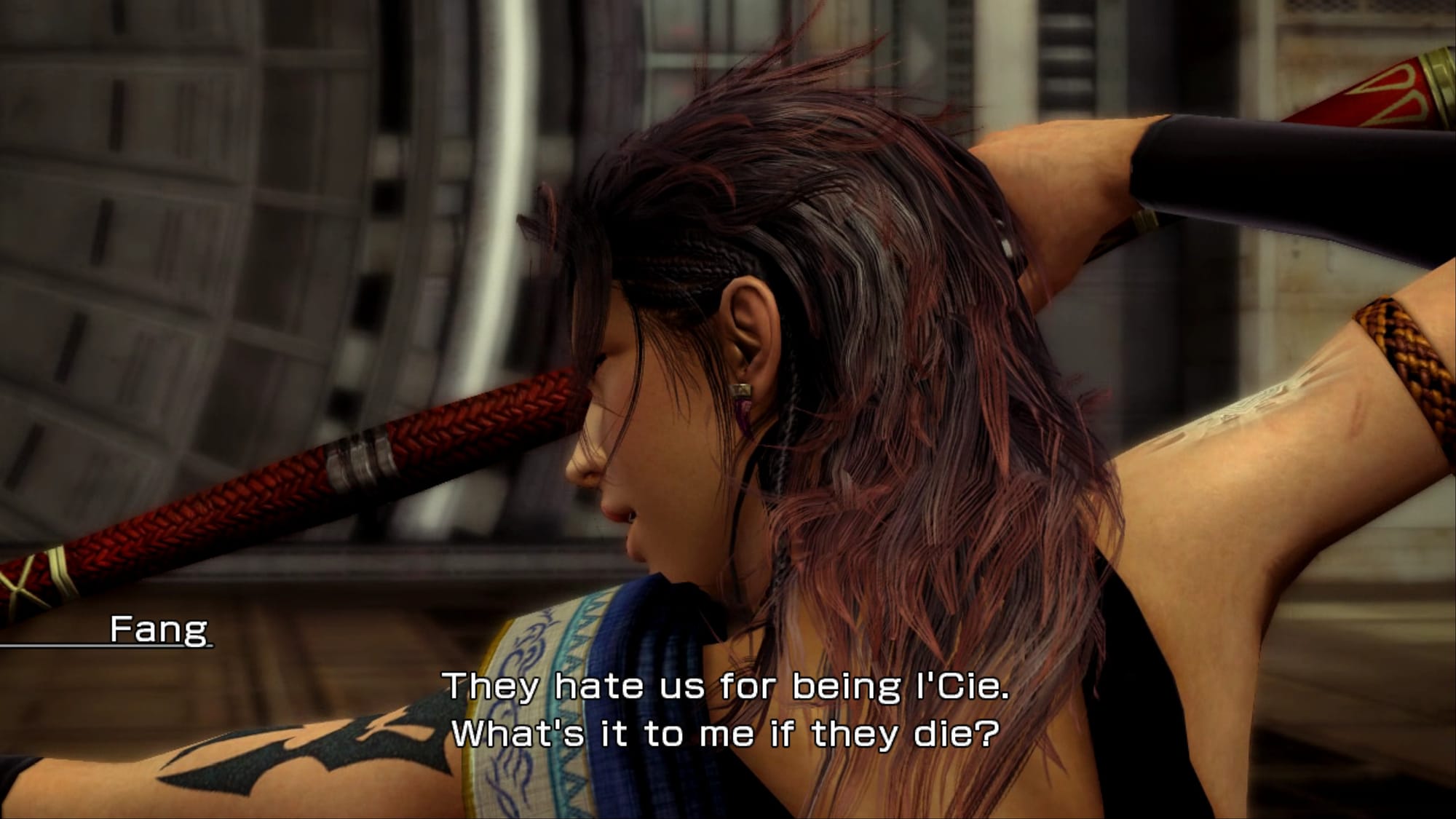
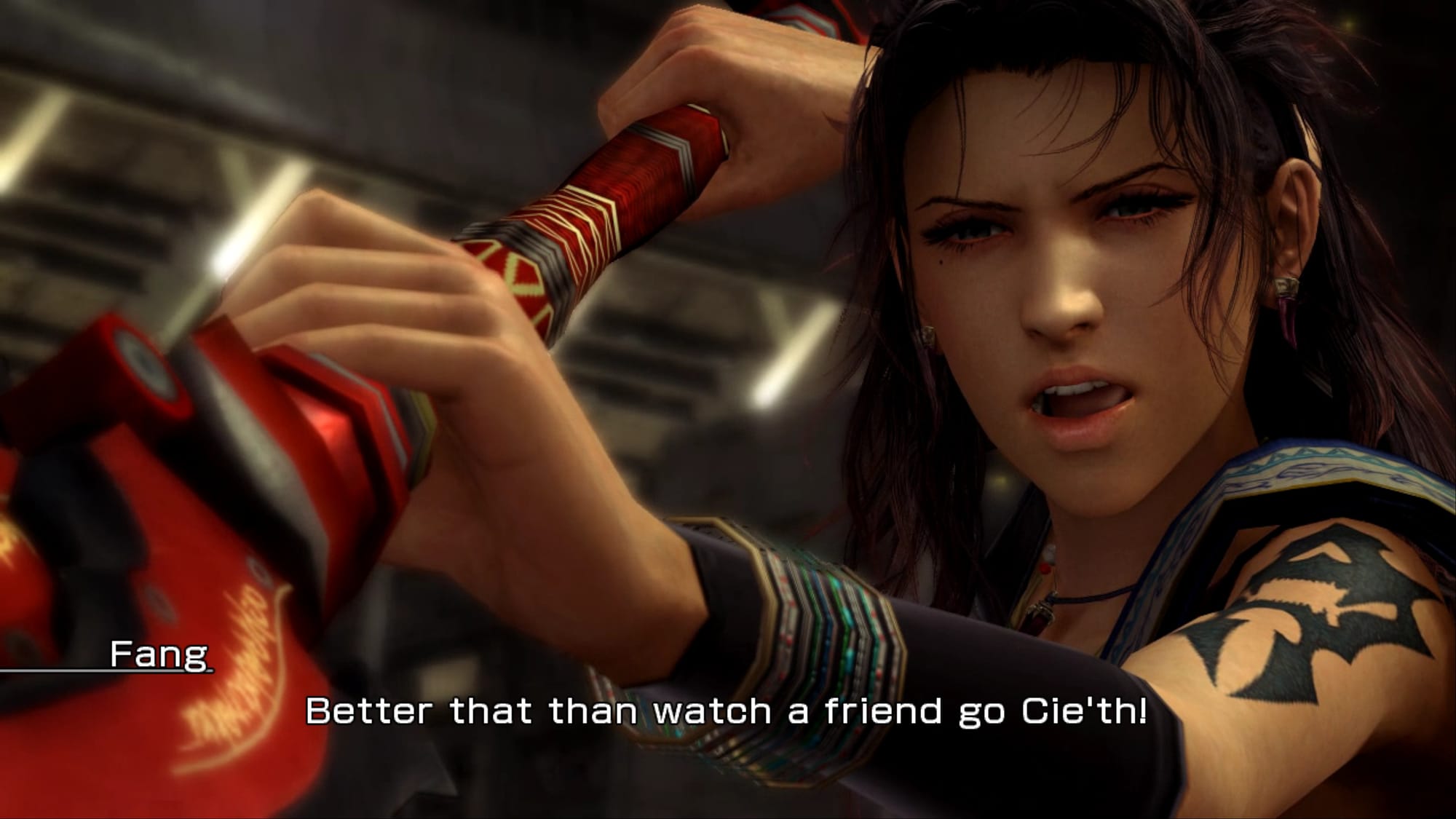
Screenshots from Fang's Eidolon Awakening
Fang and Vanille’s Eidolon fights are similarly poorly built up to—though I’d say their two battles have at least some attempts at narrative groundwork laid out beforehand. For instance, before Fang’s Eidolon awakening it had been established that she was mostly teaming up with the rest of party to help her ride-or-die Vanille fulfill her Focus. As such, her coming into conflict with the rest of the team over choosing to actively run away from their Focuses makes some dramatic sense. However, the actual climax of this conflict, like most of the character conflicts in the final four chapters of the game, is all pay off without adequate set up. Or more accurately, the set up came 5-7 hours ago and there were no further escalations of the conflict between that initial set up and the denouement.
Again, this is a shame because the baseline for these characters and their inner and interpersonal conflicts is good! We’ve already discussed Sazh and Hope a little, but I want to delve into some of the others as well, particularly the game’s protagonist. Lightning is the game’s ostensible protagonist and one who has gotten somewhat bashed over the years due to comments from Motomu Toriyama linking her to Cloud, the protagonist of FFVII. To be fair, Toriyama saying he requested character designer Tetsuya Nomura create a design that would be “someone like a female version of Cloud” is maybe not the best move in hindsight. However, trying to link your brand-new entry in a mega franchise to its most successful predecessor likely made sense at the time. Unfortunately, said comparison has obscured the actual interesting qualities of Lightning as a protagonist. There’s a lot of good conflicts she has with the rest of the cast—her initially hostile but then mentor-esque relationship with Hope is one prior mentioned example—but her conflict with Snow over her sister Serah is also one of the more well-executed interpersonal dramas within the game as a whole.
Throughout the game, flashbacks to before the Purge reveal more about Lightning and her relationship to Serah. Their parents passed away at a young age, leaving Lightning to take on a parental role for her younger sister. As a member of the civilian para-military group called the Guardian Corps, Lightning is a knowledgeable fighter whose many years of parentification and military training have left her emotionally cold and distant from her sibling. When Serah gets engaged to Snow, a member of the anti-government group N.O.R.A., and reveals that she has become a Pulse l’cie, Lightning enters parental mode and tries to shut the relationship down and take control of the situation.
This fails of course: Serah turns into crystal and Lightning becomes a government fugitive l’cie as well. Without any structure to guide her, Lightning sets her mind on destroying the Sanctum. After a life of protecting her sister and taking commands from others, she has no clue what to do than create a new target for her to take down. It’s only though that relationship with Hope that she comes to realize her coldness and military precision only alienated Serah from her. She then tries to course correct Hope away from his revenge plans and accept Snow’s relationship with Serah.
Lightning is not a particularly likable character most of the time. She’s rude to just about every other party member for the first 10 hours of the game, including a literal grieving child. However, that unlikability is not a bug, but a feature. Lightning’s past family trauma, military career, and devastation at the loss of her sister all inform her callous behavior toward others and her arc is about her realizing her faults.
This is a common theme across the entire main cast of Final Fantasy XIII. Common complaints about the central party members are that they aren’t likable: Hope is a whiny, naïve child, Vanille is too peppy, Snow braggadocious and in over his head. When you take a look at their overall arcs though, it’s clear these faults are 100% intentional and much of their narrative arcs are focused on overcoming them. Certainly, we can argue about the success of said character arcs! Personally, I find Snow frustrating and think the game doesn’t do enough after a certain point to make him confront the limitations of his simplistic Heroes vs. Villain’s perspective.
However, when I read or hear people complain about Hope being annoying, I do get frustrated. He’s a 14-year-old teenage boy who has become a government fugitive and watched his mom get killed by his government in the span of 24 hours… He’s going to be fucked up and erratic about that. Similarly, people who complain about Vanille’s overly happy exterior seemingly miss the point about those characteristics being a mask that hides her inner doubts and worries. As a resident of Gran Pulse now reawakened thousands of years later in enemy territory, she disguises her fear and anxiety via her peppy attitude (admittedly, the Edge magazine review is right about her being oversexualized though).
An area of critique around the game’s writing that I can get behind though is its general plot legibility. This is something I have to check myself on, because it turns out hyper-focusing on a game when you’re in middle school means that a lot of the aspects of it that people complain about being confusing are to me perfectly self-explanatory. For example, people often have talked about the amount of terminology thrown around in the opening hours being confusing. Terms like l’cie, fal’cie, and cieth are thrown around without much initial explanation to clarify what any of them mean.
Certainly, the intro of the game itself is quite disorienting: the player is launched into the middle of this government-backed Purge of those who came into contact with the Pulse fal’cie. What is a fal’cie? What is Pulse? These are questions that are slowly answered in story cutscenes over the remainder of the opening chapters via flashbacks and occasional clarifying exposition. The writers clearly were aiming for a less intrusive approach to worldbuilding, keeping expository moments confined to scenes where characters who lack cultural context, like Vanille, start to ask questions about their surroundings. Furthermore, additional worldbuilding can be found in the game’s much maligned Datalog, an index of character, story, and lore information available in the main menu.
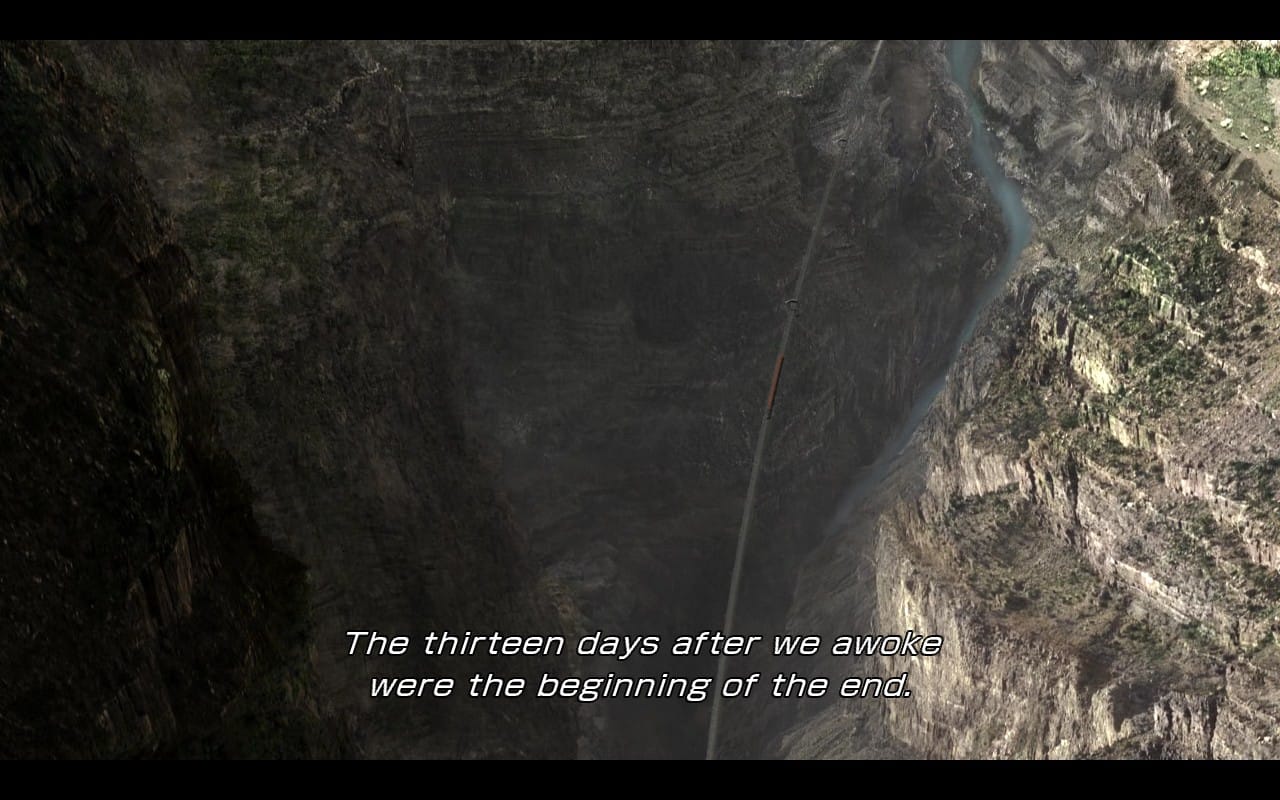
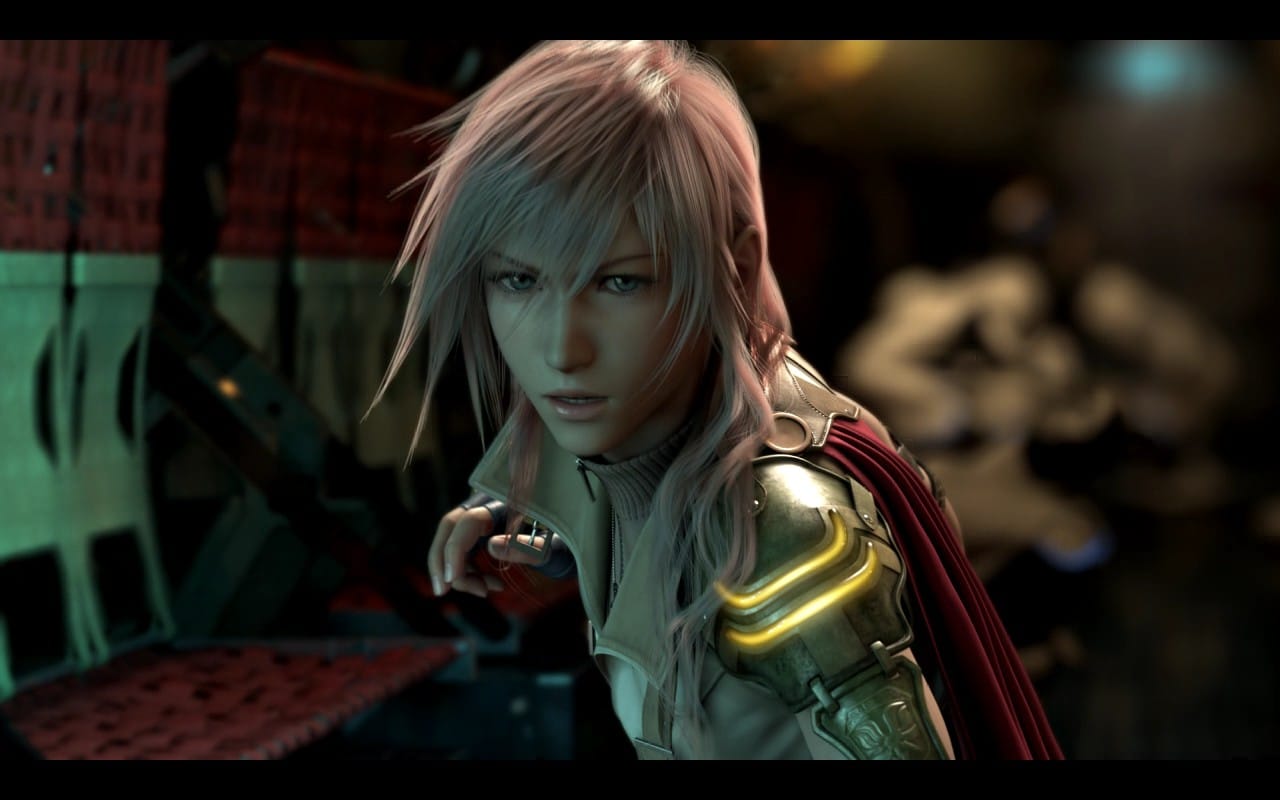
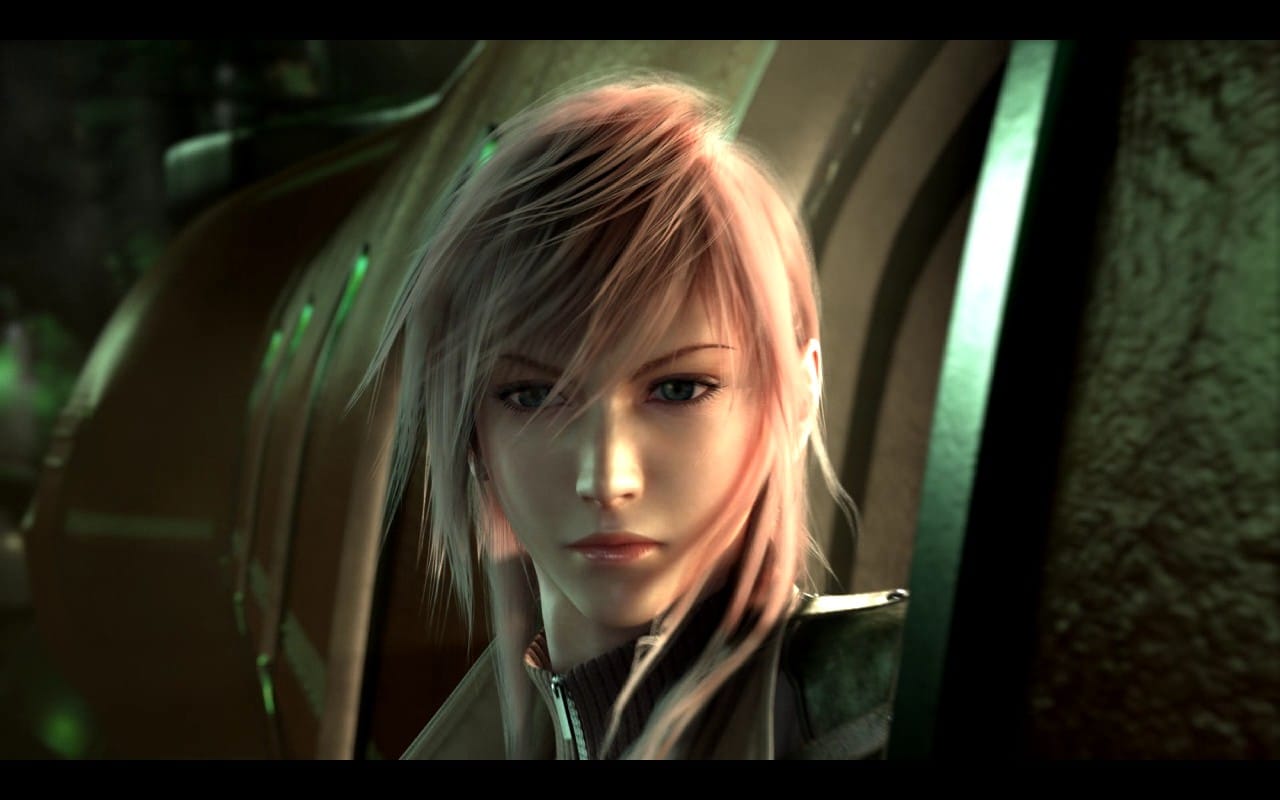
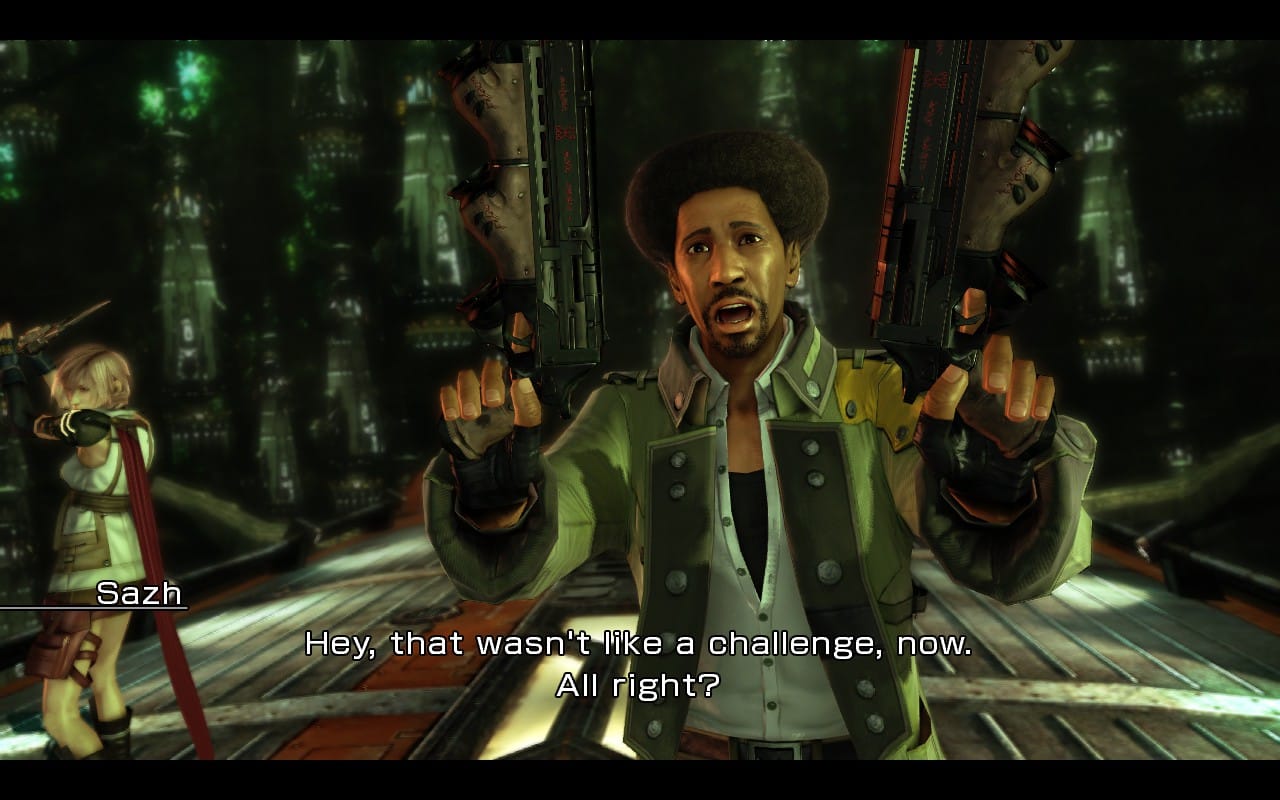
Screenshots from Final Fantasy XIII's opening cut scenes
Personally, I like Final Fantasy XIII’s approach to its opening hours. The train heist at the beginning is reminiscent of Final Fantasy VII’s in the sense that it throws the player directly into the action, but tonally the disorienting nature of the sequence gets the player to ask questions. Who are these characters? How did they end up in this life-or-death situation? The following hours slowly unspool this, revealing more narrative context to keep the player hooked.
For many players at the time though, they found the disorientation to be more off putting than compelling. Particularly since the game highlights the Datalog in a tutorial, I think many players took those instructions as a sign that the game’s story cutscenes would not be enough to fully flesh out the narrative and characters. This is why when you dig through forums and old fan reviews you might spot complaints saying reading the Datalog is necessary to understand anything that happens in the game… This is simply not true and again points toward the game once again tutorializing worse ways of engaging with it.
Still, there are moments where the logic of the game’s plotting is not entirely coherent or clear cut. To me, this is most evident in the game’s final two chapters. At the end of Chapter 11, after hours of the characters attempting to find away out of their supposed Focus to “destroy Cocoon” by searching Gran Pulse, the party once again gets into a fight with the Cocoon fal’cie Barthandelus. Upon defeat, Barthandelus reveals that he has revived Cid, a former ally of the group who was revealed to be a Cocoon l’cie hours earlier, and placed him at the head of the Sanctum. As a former member of the anti-Sanctum military group called the Cavalry, this betrayal will lead to the Cavalry killing Cid and then Orphan, the fal’cie who keeps Cocoon afloat in the air. This is all connected to the Cocoon fal’cie’s broader plan to revive the ultimate creator being that made all fal’cie by destroying Cocoon. How Barthandelus can so accurately predict this plan will work out is not clear, but he is a robot god-being so my suspension of disbelief can be applied there.
Where things get a little harder to believe is the main party’s decision to go back to Cocoon to stop the Cavalry from killing Orphan. Fang rightfully points out that this plan is a total trap that will inevitably result in them being the same room as Orphan, who Barthandelus wants the group to kill in order to enact his crazy god revival plan. Still, the gang ultimately agrees that they could save more lives by trying to stop the plan than by doing nothing. Already, the suspension of disbelief is being stretched here a little bit, but still I continued to try to suspend it—to give the game some narrative good will. But then, at the end of Chapter 13, after going through the Cocoon capital of Eden and seeing almost all of the Cavalry soldiers turned into Cieth along the way, we’re supposed to be shocked when the party enters Orphan’s chamber and it turns out none of the Cavalry are still alive and Barthandelus set this all up to lead them to kill Orphan!
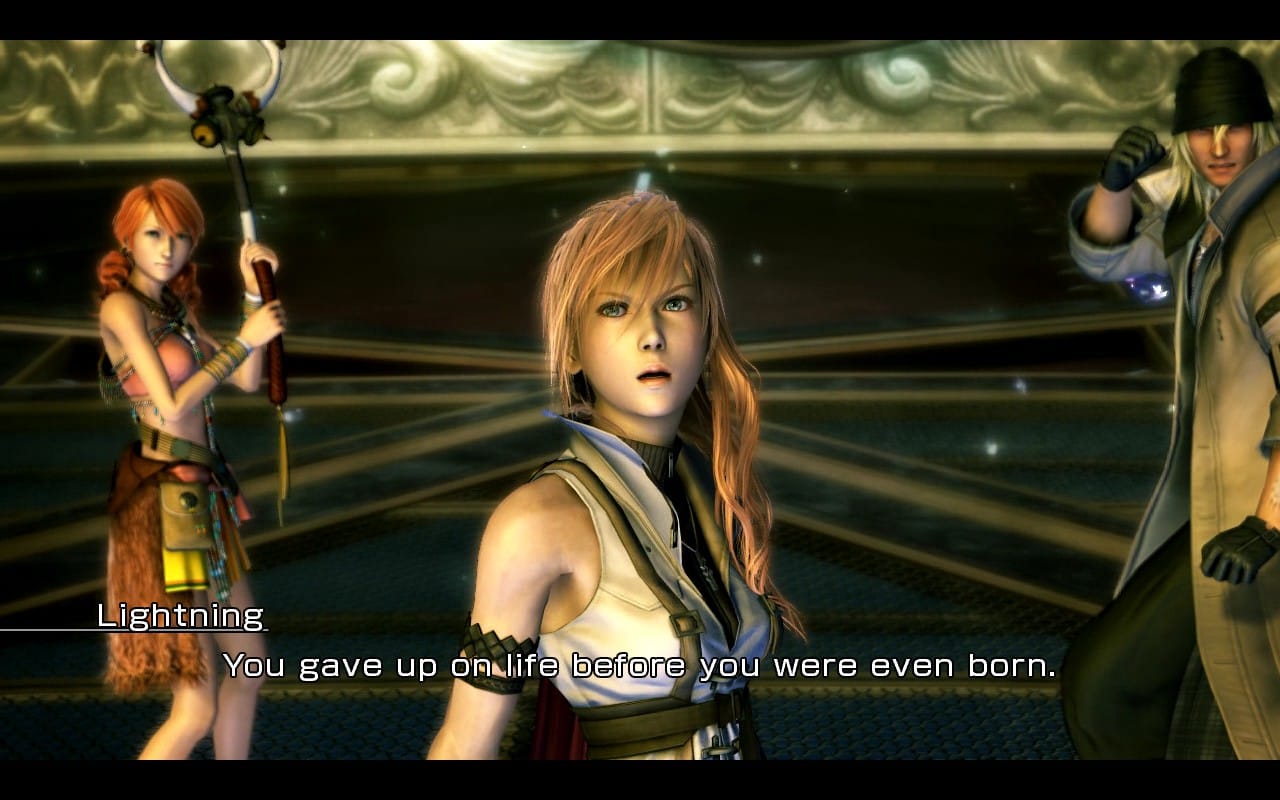
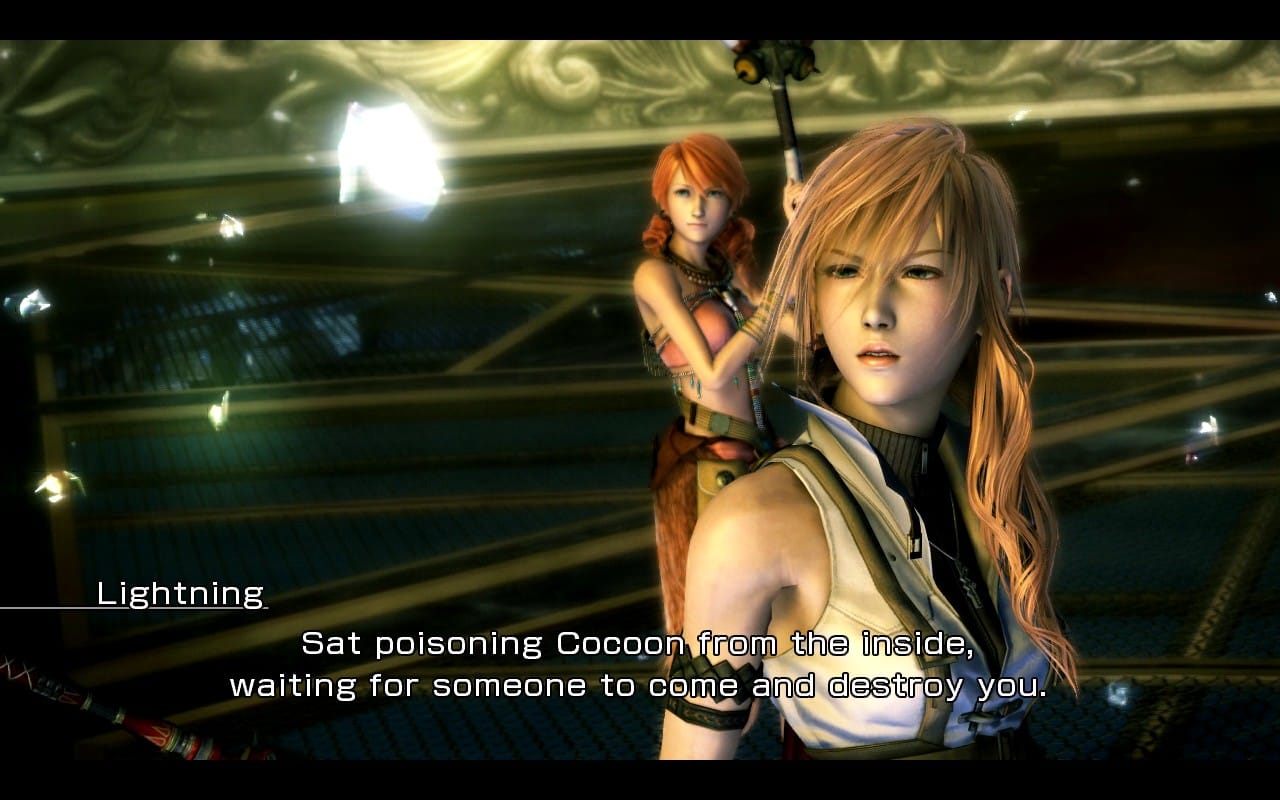
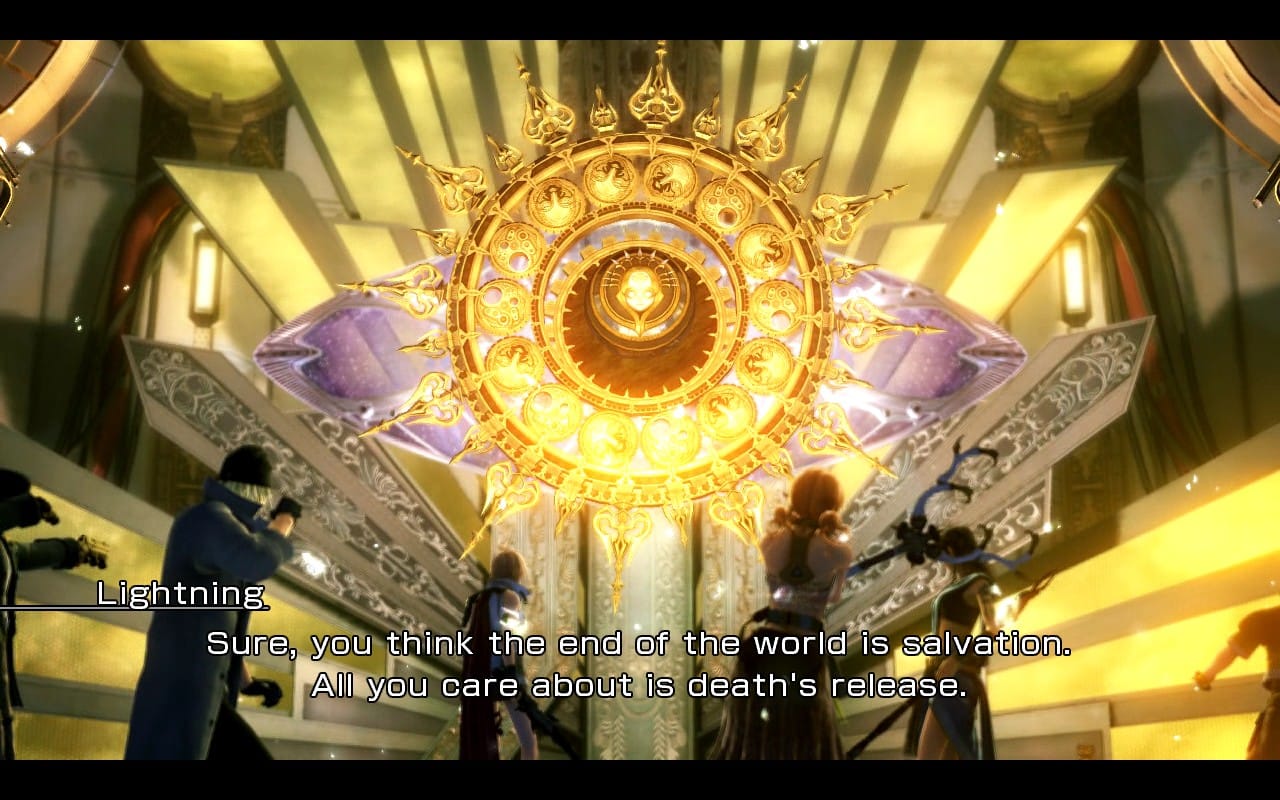
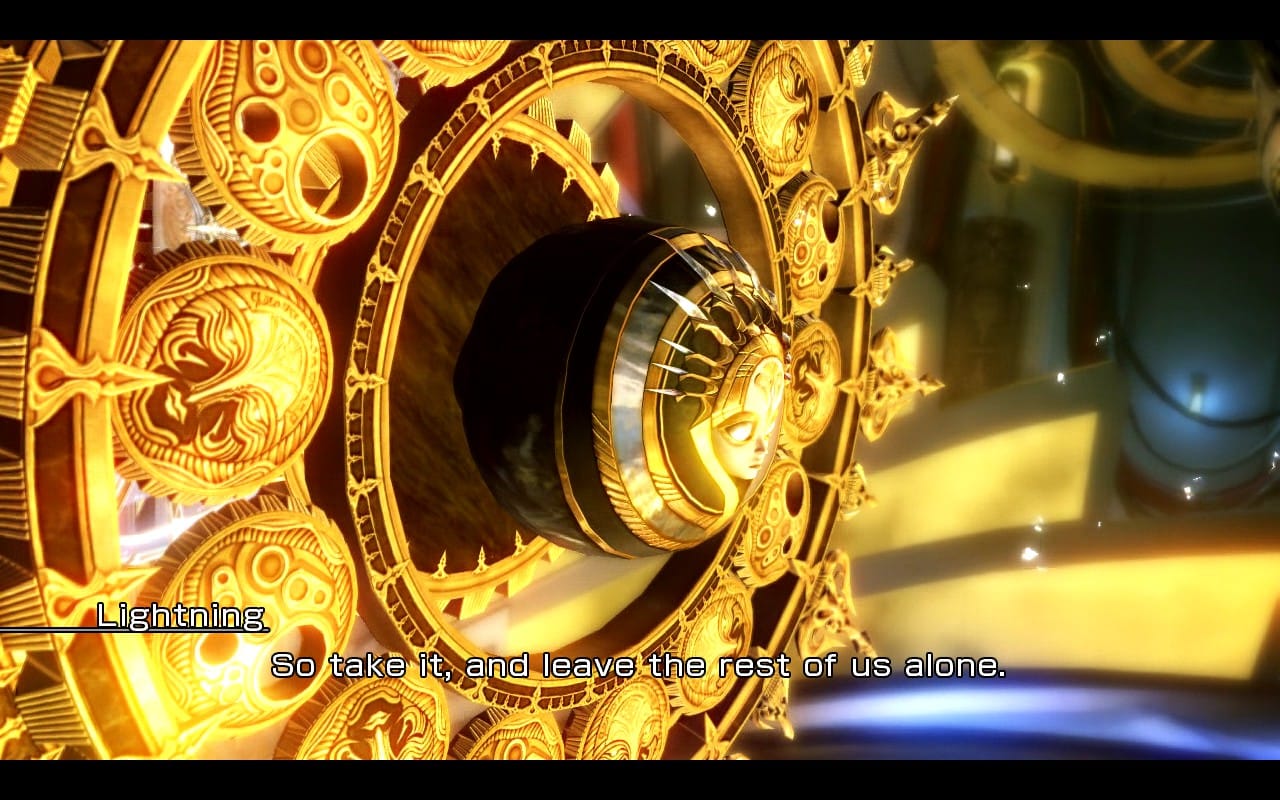
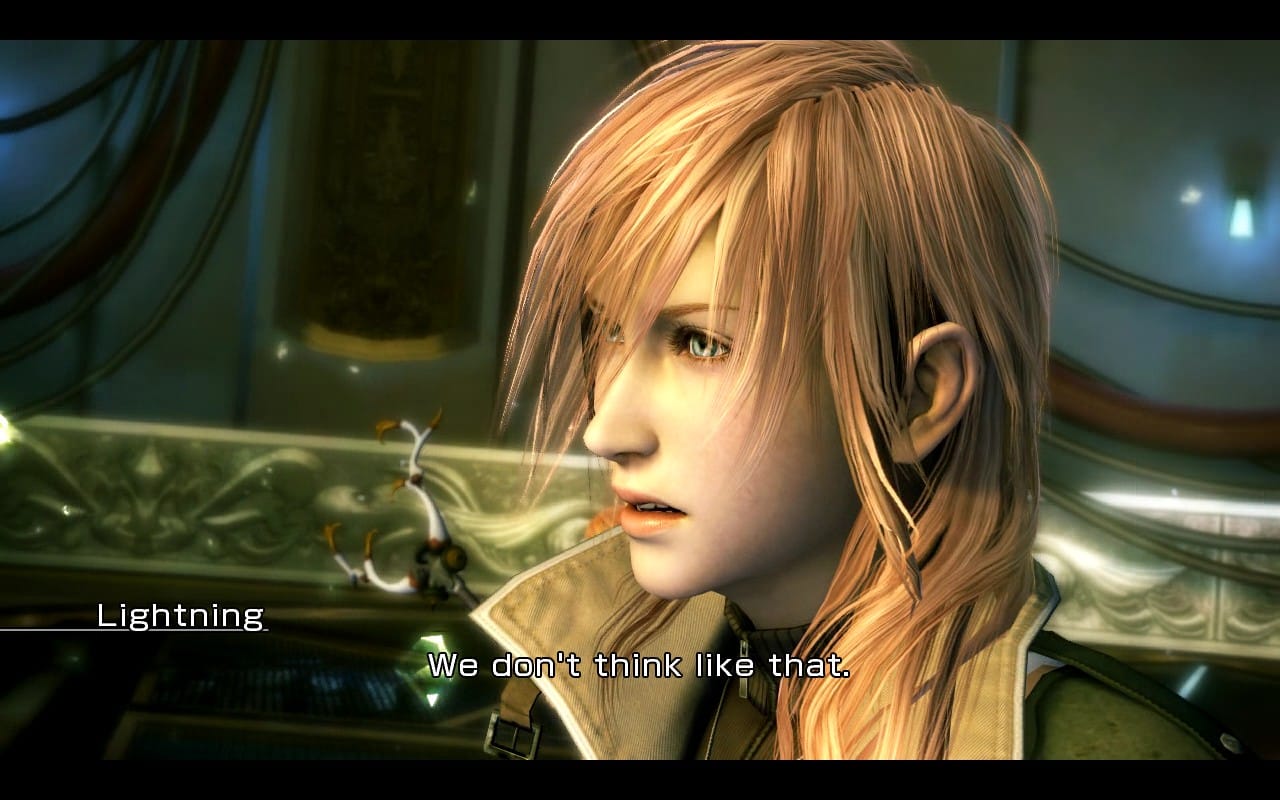
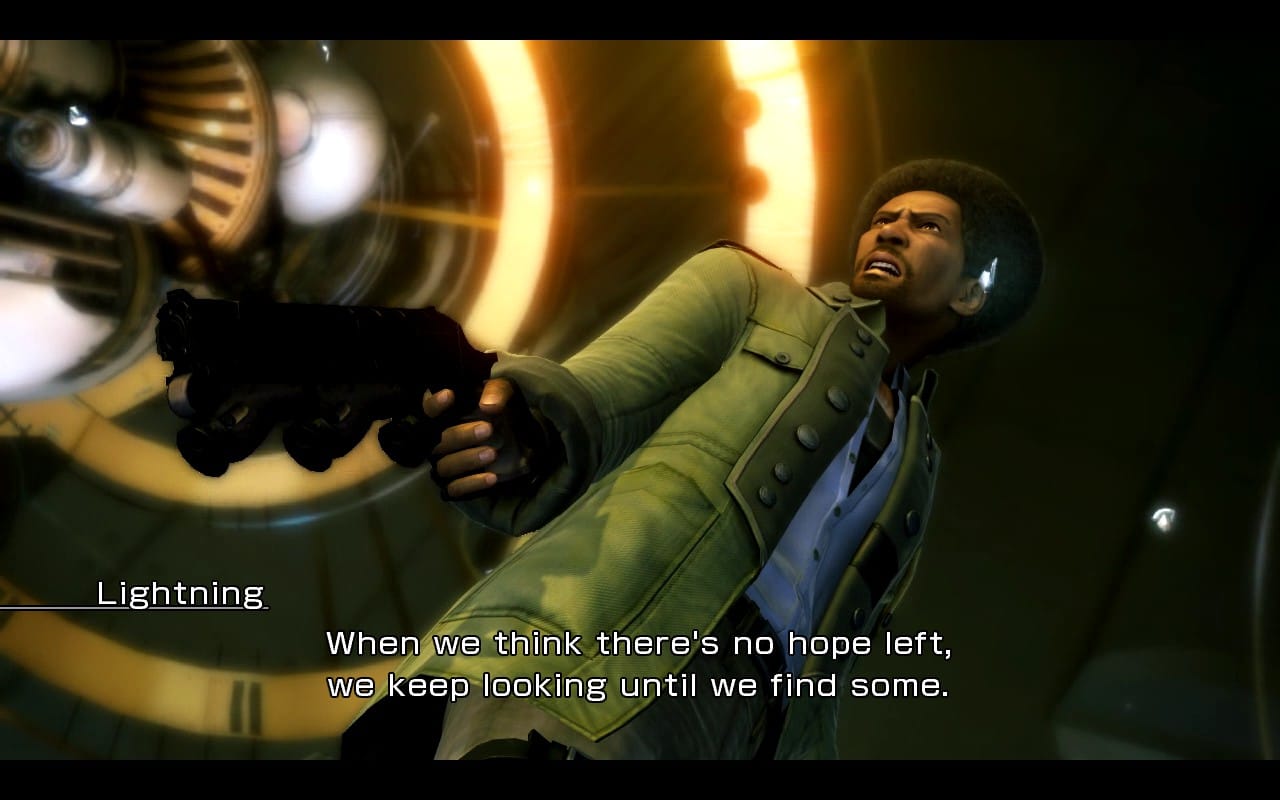
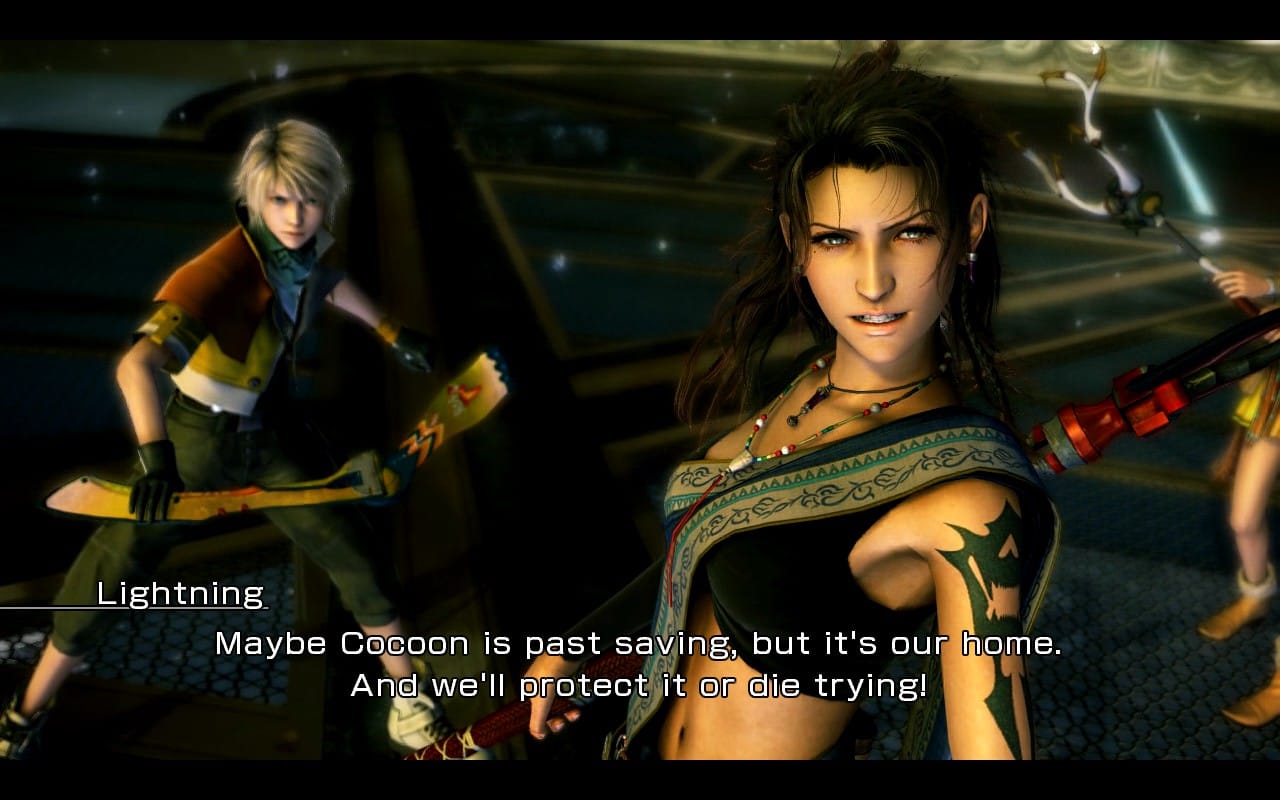
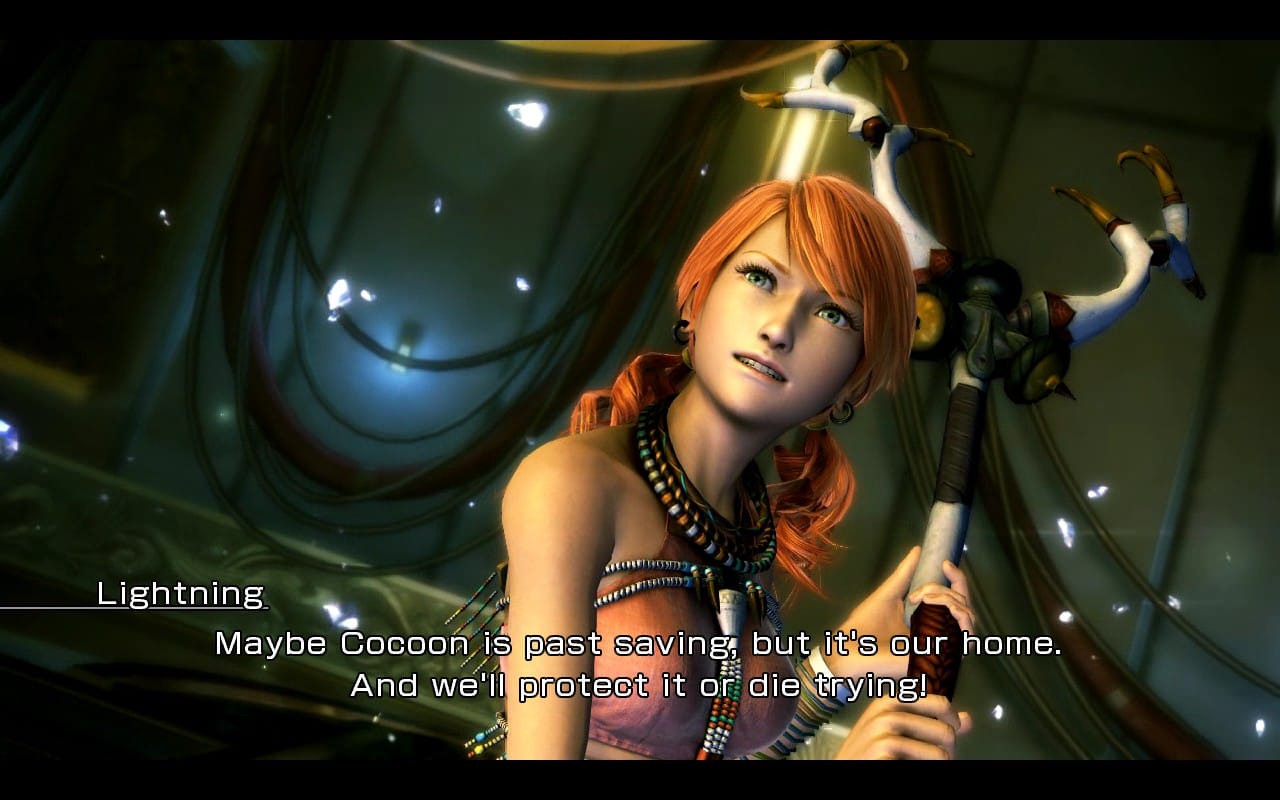
Lightning's Epic Monologue to Orphan that makes you scratch your head if you think about the civilian implications.
What follows is a rather thematically interesting, but logically fraught climax. From the perspective of the game’s themes of fate and free will, what happens in this finale is rather compelling. The group comes close to total demise with most of the party transforming into Cieth. However, when things seem most dire, the group revives and decides to destroy Orphan. Although they know this decision will potentially result in millions of deaths and the destruction of Cocoon, they still would rather chose their own fate and end this era of fal’cie control over humanity. It’s a powerful narrative moment—one where the characters overcome the inevitable Cieth transformations they’ve all feared over the course of the game in favor of taking control of their own destinies and believing a better world is possible.
Still, for all its thematic weight, these plot points raise more questions than I think the game is equipped to answer as it rushes toward the finish line. For one thing, this is a rather rash decision to make in the face of millions of innocent Cocoon civilians’ lives. Like we’re really going to kill the god being holding up this floating city at the expense of what any of Cocoon’s residents think?
Luckily, the game does have a good solution to this rather big issue as Fang and Vanille in an act of self-sacrifice transform into a creature called Ragnarök and use their heightened magical abilities to raise a spire of magma from Pulse. As the two crystallize upon completing their Focus, the magma turns to crystal as well, holding up Cocoon in the sky even without fal’cie intervention. The image of the two wrapped around Cocoon in crystal reveals itself to be the image that makes up the game’s logo. In another miracle, the rest of the party, including Serah and Sazh’s son Dajh, are awakened from their crystal slumber. It’s a visually striking ending and an emotionally powerful one. Vanille and Fang, residents of Gran Pulse, sacrifice themselves for the sake of their friends and humanity. Fal’cie can no longer reign with fear and cruelty on Cocoon and the rest of the party are reunited with their lost loved ones.
Again though, the leaps made to get to this conclusion are kind of confusing and suspect. If the game slowed down and took more time in its final chapters to build up to these decisions, I would be more easily swayed to defend them. In their current form though, these climactic choices somewhat strain believability. For example, why would Fang and Vanille, who up until this point have been mostly treated like shit on Cocoon, sacrifice themselves for it? I understand why the game wants me to believe this decision would be possible for the two of them—they have at this point spent a lot of time on Cocoon and bonded with the rest of the party who are residents of it. Still, some character-building moments where the two reflect on their changed attitudes would’ve been nice. Similarly, I can buy the party making the decision to destroy Orphan despite the consequences if there had been prior build up, but for the previous chapter it seemed like they were dead set on stopping the Cavalry over doing that. Just some more narrative build up is all I’m asking for here!
That being said, the ending is quite powerful in terms of one remaining aspect of the game that I have somehow not yet touched upon…
Part IV: The Power of Yuri & Final Thoughts
Something that has become evident to me about Final Fantasy XIII as I’ve aged is its status as the last single player, mainline Final Fantasy title to have any kind of gender parity with its playable party members.
That was not something I expected as a teenager since going back to older entries in the franchise revealed a series that always usually had at least a couple female party members. Whether or not the game handled these characters with care or equity is certainly up for debate, but nonetheless I have always appreciated Final Fantasy for its attempts at inclusion. Several of Final Fantasy’s most iconic party members are women like Aerith and Tifa. This isn’t even getting into some of my personal favorite FF characters like Freya and Garnet from FFIX. For FFXV and FFXVI though, the franchise has focused on primarily male casts.
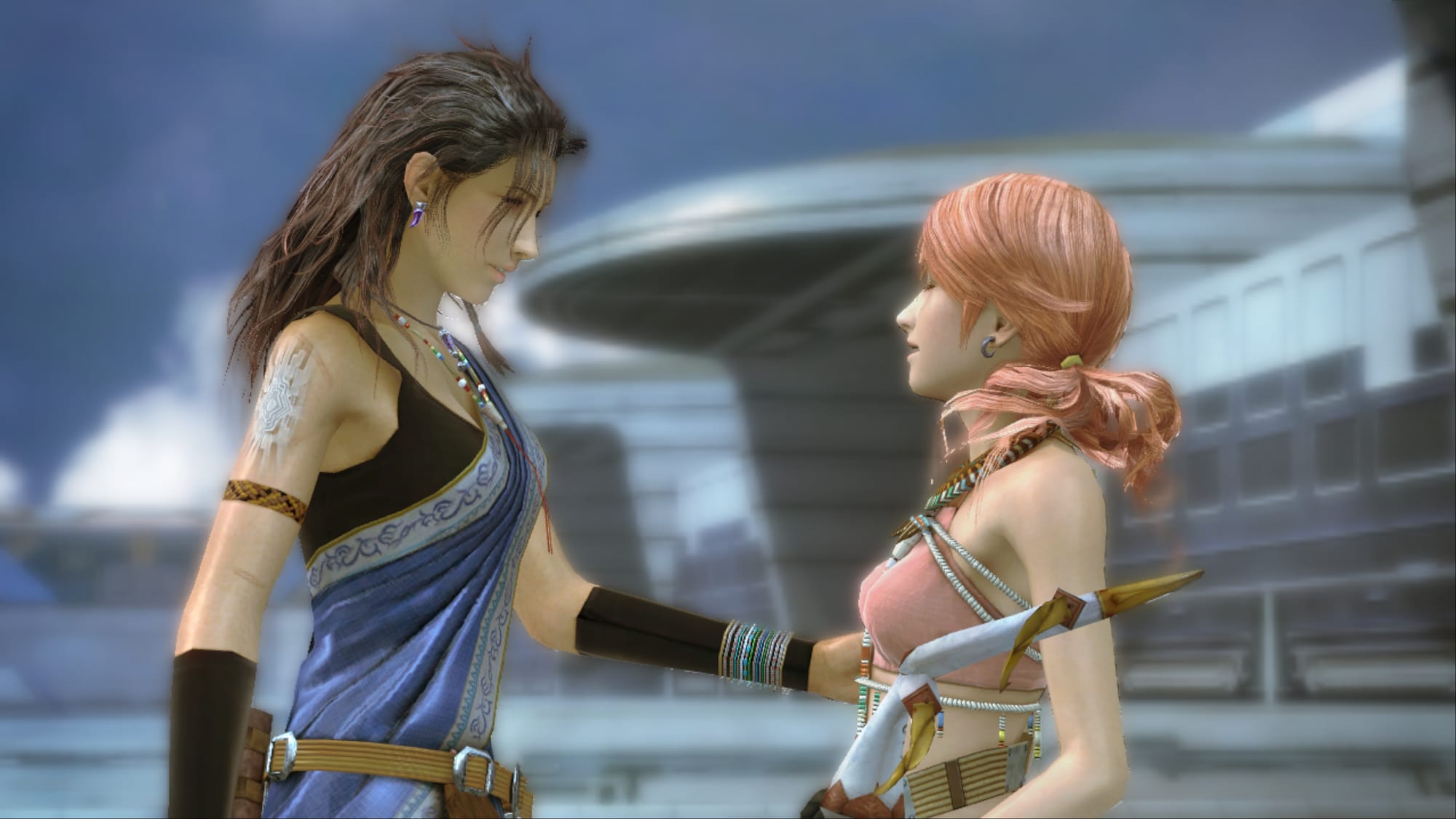
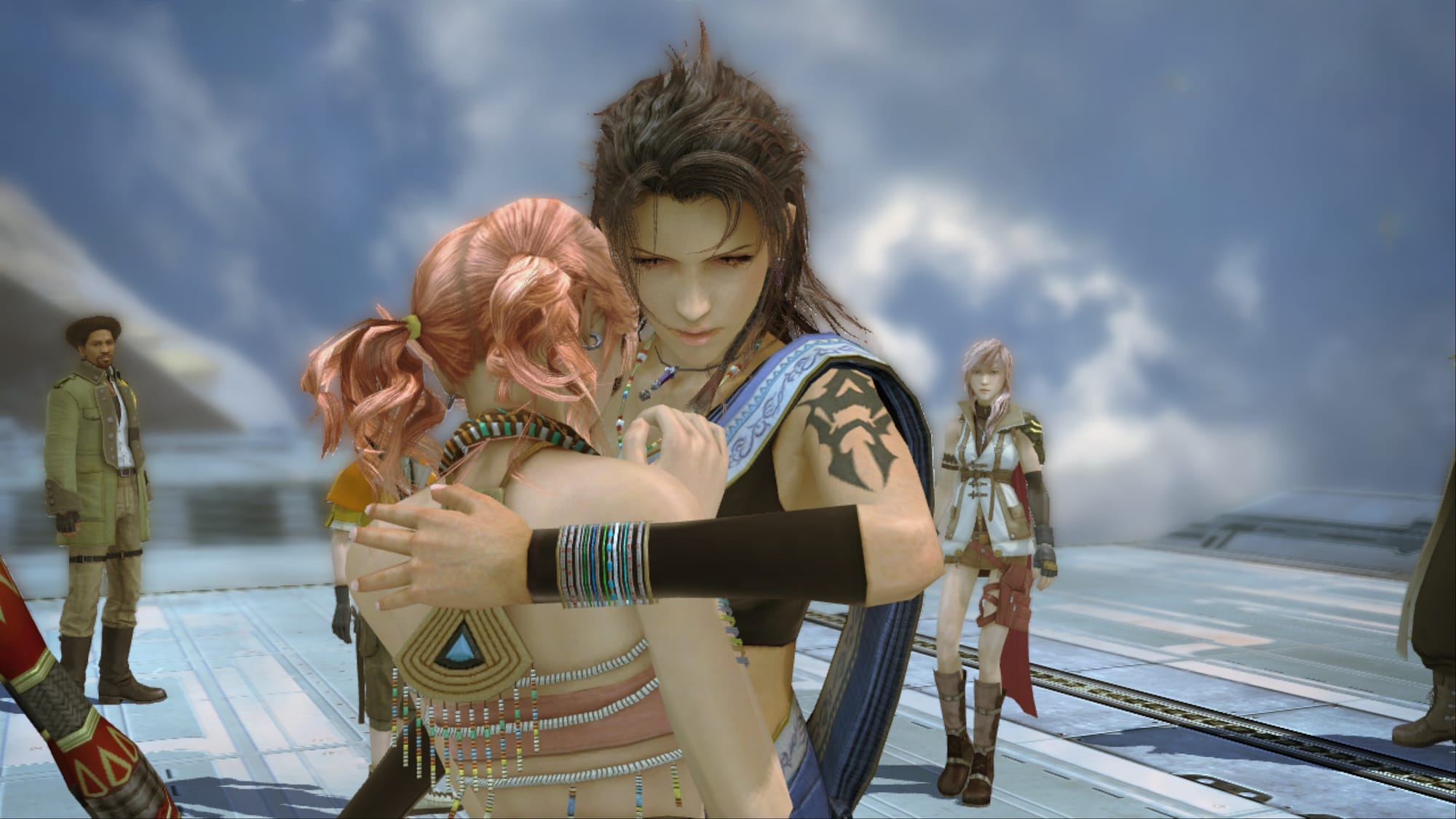
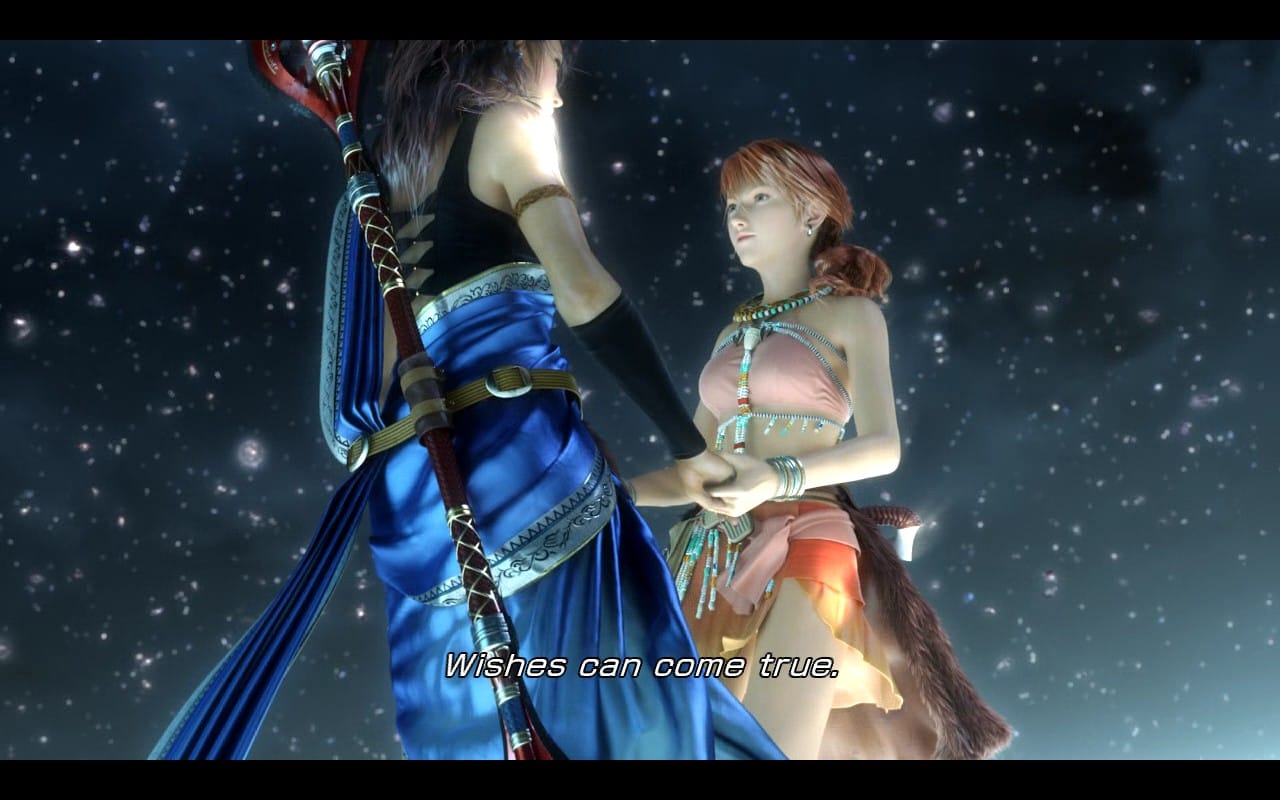
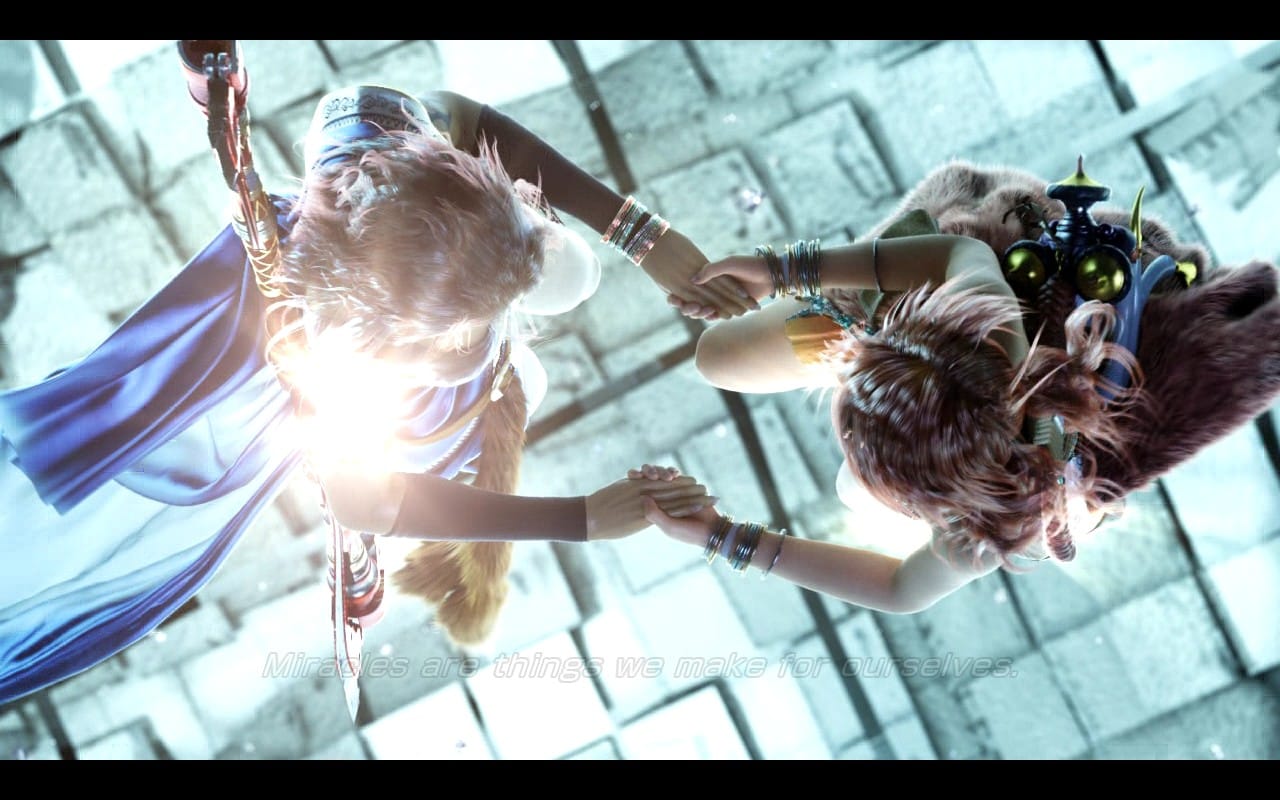
Fang x Vanille Yuri Evidence.
This is a shame, because while Final Fantasy XIII’s female party members are interesting, complex figures in many ways. I’ve already discussed Lightning in detail, but really my favorites are Vanille and Fang. Vanille and Fang in retrospect are quite possible the first lesbian coupling I ever encountered in fandom and in media more broadly. While Vanille and Fang are not explicitly lesbians in the game, in proper yuri fashion the subtext and vibes between the two are off the charts. Fang with her brash, bold, and protective demeanor is a prototypical futch in my mind. She can beat you up, but her mascara is also always on point. Vanille meanwhile is the perfect pair for her: her optimism and girlish personality subduing Fang’s more cynical tendencies. Combine these character traits and dynamics with the two of them being childhood friends who lived in a communal village AND the game literally ended on an image of them holding hands in crystalline form… Well, the seeds for yuri-fever are right there. I mean, to some extent, the ending of the game is all about lesbianism saving humanity!
In general, the dynamic between Fang and Vanille represents both Final Fantasy XIII at its best and worst. Vanille and Fang are compelling, messy, complicated female characters. Vanille uses her peppiness as a mask to hide her fear of hurting those around her due to her status as a Pulse l’cie. Time and time again, she tries to run away from her problems and put on a smile only to be confronted with the consequences of her past actions. Fang meanwhile faces her past head on and tries to protect Vanille, but at the expense of acknowledging the humanity of everyone else. In her desire to become a shield for Vanille, she in turn closes herself off from imagining a better future.
At the same time, so many aspects about these two characters and their relationship with each other are unexplored. I already went over the missed opportunities on Gran Pulse to explore their backstory together, but I think they are worth reiterating since it is such a clear example of the game’s strange sense of priorities. Here we have two characters who have been displaced from their original time period and have now come back to their hometown to discover it decimated.
In an older Final Fantasy title, an area like this would be a chance to slow down and give us some character beats, maybe a side quest of two to flesh out this location and these characters’ relationship to it. Thankfully, there is one non-Cieth stone side quest located here, but narratively it doesn’t add much. If you enter one of the homes in Oerba, players can find a broken-down robot from Vanille’s childhood called Bahkti. What follows from there is a short fetch quest to find repair parts for it. If you successfully locate all the parts, Bahkti revives and gives you some rewards and a couple facts about various Gran Pulse locations. Unfortunately, though, that’s it. There are no details about Vanille’s past, the people she regarded as family, or her childhood with Fang.
Retrospectively, one can look back at Final Fantasy XIII and see that in many ways the game was doomed from the start. The combination of changing leadership, new forays in HD game development, and a change in combat system were bound to cause some stir among fans. Still, it is also fair to say that many of the issues with FFXIII are due to developer decisions. How a game chooses to teach a player to engage with its mechanics and narrative are important and time and time again the developers of Final Fantasy XIII chose handholding to the detriment of actually letting players experiment with the systems they created. I swear if the tutorials in this game prioritized experimentation and didn’t mention the Datalog at all, the reception of this game would have been a tad more generous amongst long-time FF fans during its launch. Additionally, delaying the game to give the latter half adequate polish from both a gameplay and narrative standpoint would go a long way to shaving off the game’s rougher edges.
Alas, even as my rose-tinted vision of Final Fantasy XIII has been thoroughly dismantled when playing it in a modern context, I can’t help but still be charmed by it. For all its faults, there’s something very earnest about it. In many ways Final Fantasy XIII might have set the standard for future post-Sakaguchi FF titles with its Call of Duty trend-chasing and its desire to push its combat mechanics in a more fast-paced, action-oriented direction. Yet, unlike Final Fantasy XV and XVI, there’s still an undeniable crunch and quaintness to the choices being made that I appreciate. Final Fantasy XIII has a bold, overly ambitious quality to it. It wanted to be a grand science-fantasy story about fate and free will with an innovative combat system and a melding of traditional JRPG melodrama and linear FPS game design. In its attempts to hit soaring highs, it occasionally landed, but for the most part has aged to become a very undeniable product of its time.
Still, as Fang and Vanille hold hands in crystalline form and a corny ballad leads players into the game’s credits, I can see what the developers were going for and admire their chutzpah. Final Fantasy XIII may not be a great game, but it is an imminently interesting one. I will always have a fondness for its messy cast of fugitives seeking meaning in a cruel world bent on scapegoating the other in favor of commodified/illusory comforts. In the end, the game begs its characters and players to believe in something and forge their own path, no matter the consequences or how naive that path might seem. This is much in the same way the game itself charts its own unique vision of what a JRPG can be: a vision that ended up coming with quite mixed results and consequences of its own.
As always, thanks for reading.
Articles Sourced, Quoted, and Referenced (In Order of Appearance):
“In Defense of Final Fantasy XIII.” By Harper Jay. Published on Kotaku.
“Review: Final Fantasy XIII.” By Edge Staff. Published via Edge Magazine. Retrieved via Wayback Machine.
“Final Fantasy XIII is Not an RPG” By Jeremy Parish. Published on 1Up.com. Retrieved via Wayback Machine.
“The Mind and Heart of Final Fantasy XIII.” By Christian Nutt. Published on Gamedeveloper.com.
“Final Fantasy XIII boss responds to review scores.” By Tim Ingham. Published on CVG. Retrieved via Wayback Machine.
“This is Phil Fish.” By Innuendo Studios. Published on YouTube.
“An Interview with Final Fantasy XIII’s Kitase & Toriyama.” By Jem Alexander. Published on Playstation.com.
“Final Fantasy XIII’s Motomu Toriyama and Yoshinori Kitase – An Interview.” By Gerald Lynch. Published on Tech Digest.
“FFXIII Interview: Nomura, Kitase, Hashimoto and Toriyama.” By Luke Smith. Published on 1Up.com. Retrieved via Wayback Machine.